

Did you know? Anyone can paint their own house! For those who are tired of the old color and want to change to a new style that is not monotonous, and wish to paint by themselves without spending money hiring someone, today, Beger has easy steps for beginners to paint their house beautifully, just like a professional. I can tell you that it’s not as difficult as you think. Let’s understand and start doing it through the following 6 steps.
Choose to read by the topic of interest
Steps to paint your house by yourself
- Check the condition of the house surface
- Prepare painting equipment
- Prepare the surface
- Apply primer
- Apply topcoat
- Finish and check the neatness
6 steps to paint your house by yourself, how to start
1. Check the condition of your house surface
The very first step is to look at the condition of the house surface to see what it is like. This is because painting an old house and a newly built house will have different methods for preparing the surface and using different products.
Additionally, you need to consider the area to be painted, whether it will be inside the house or outside the house. This is because interior and exterior paints have some different properties, such as weather resistance. Generally, it is permissible to use exterior paint for interior use, but for interior walls that receive sunlight, only exterior paint should be used. However, this does not mean that you will always get the maximum benefit. High-quality interior paints have special properties that surpass ordinary exterior paints, such as being more resistant to scrubbing and cleaning dirt stains, and some models even have the ability to eliminate bacteria and viruses, as well as purify the air, like BegerCool DiamondShield 15 (exterior paint) or BegerShield AirFresh Gold Ion (interior paint).

2. Prepare painting equipment, what should you have?
Since you are going to paint by yourself, besides the paint, you need to prepare painting equipment such as brushes, paint rollers, and putty knives, as well as tape to block areas where you don’t want paint to get, like door edges or window edges.
- How to choose a paint roller?
The familiar tool that is suitable for use in large areas, mostly available in 3 sizes in the market: 4 inches, 7 inches, and 10 inches.
- How to choose a house paint brush?
The standard equipment for painting, suitable for use in limited areas, in corners where rollers cannot reach. Brush heads come in various sizes from 1 to 5 inches, and the bristles come in several types, such as grass bristle brushes, plastic bristle brushes, and animal hair brushes. We need to choose appropriately for the work, for example, a 2.5-inch paint brush is a popular size.
- How to choose a putty knife?
A trowel is a tool used for leveling surfaces, scraping off old plaster, smoothing putty marks, and creating decorative paint patterns. There are various types of trowels, including triangular trowels, putty trowels, and for special decorative paint cases like BegerShield Art Effects Loft, a BA-43 rectangular steel trowel should be used.
- How to choose masking tape?
When selecting masking tape for painting, you need to consider the adhesive residue and resistance to bleeding. This means that when removed, it should not leave adhesive residue behind, and when painting, the paint should not bleed through the edges of the tape. You can find it at construction material stores or stationery shops.

3. Prepare the surface, clean, and repair
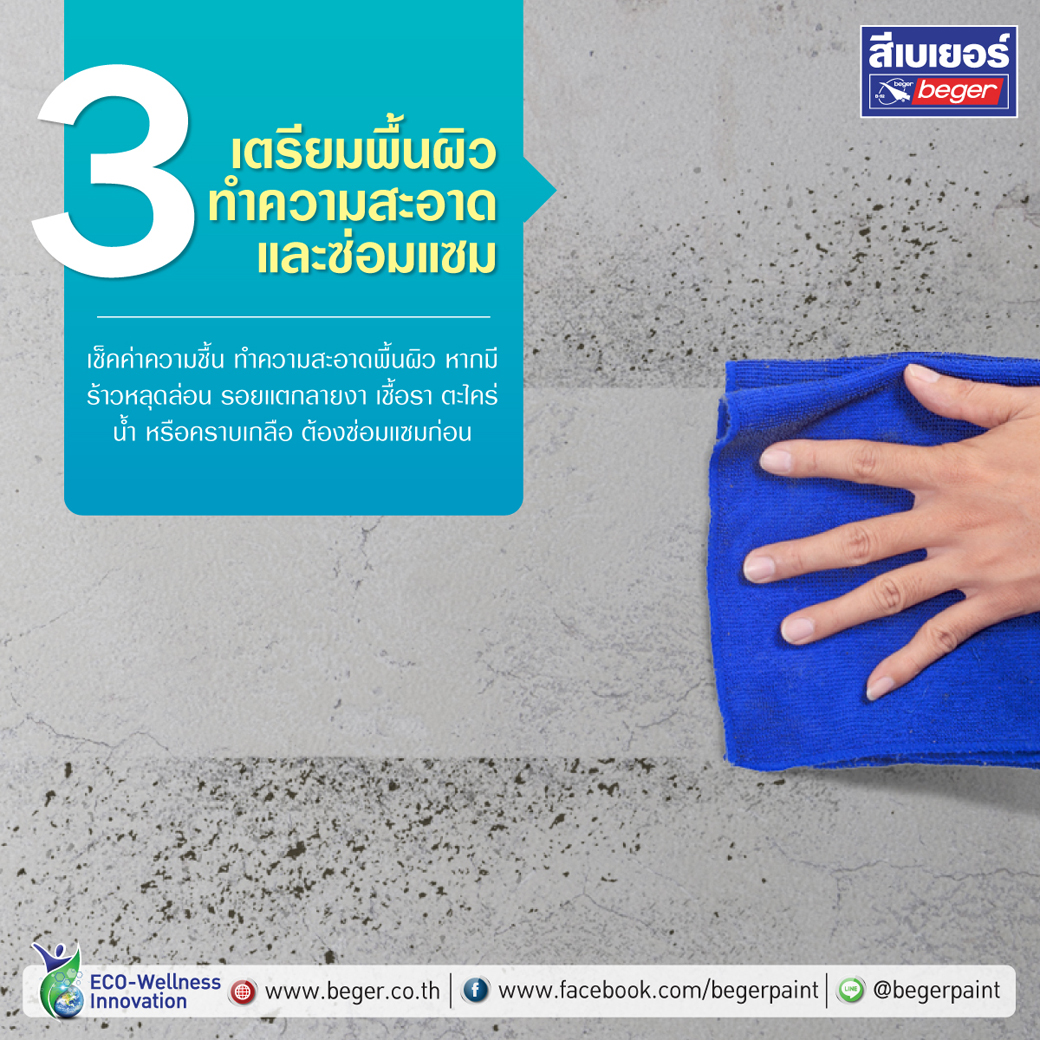
The preparation of the surface for each type of house is different. In the case of a new house, you need to check for moisture issues, with an appropriate level between 14 – 16% (when measured with a PROTIMETER moisture meter). For older houses that need renovation and have surface issues such as peeling, cracks, leaks, mold, algae, or salt stains, you must repair them before starting to repaint.
- Problem of peeling paint House paint is a product that deteriorates over time, especially in the harsh weather conditions of Thailand, which is hot and humid. If low-quality paint is used, it can easily blister and peel off. If you want to repaint, it is necessary to scrape off the old paint first.
- Problem of cracked and crazed walls This is the most common problem, caused by the wall encountering high heat and being unable to dissipate heat, leading to cracks and crazing. If the cracks are small, no wider than 1 millimeter, it is recommended to use Beger Acrylic Filler F-200 to fill those cracks first. If there are wider cracks measuring 2-10 millimeters, use Beger Acrylic Sealant F-001, which is highly flexible instead.
- Problem of mold and algae This is a common annoyance during the rainy season that can be easily resolved by simply scrubbing and cleaning the surface, allowing it to dry for at least 24 hours, and then applying Beger Mouldfree M-001 mold and algae remover 1 – 2 times, leaving it for at least 3 – 4 hours without rinsing off, and then you can proceed to repaint.
- Problem of salt stains When water or moisture seeps in and reacts with the cement, it dries and leaves white salt stains on the surface. These stains can be scrubbed away, but to prevent them from recurring, you should fill the cracks before applying the primer paint, such as Beger Water Block Primer B-3100 / Beger Pro Quick Primer B-1900.
4. Apply primer suitable for the surface
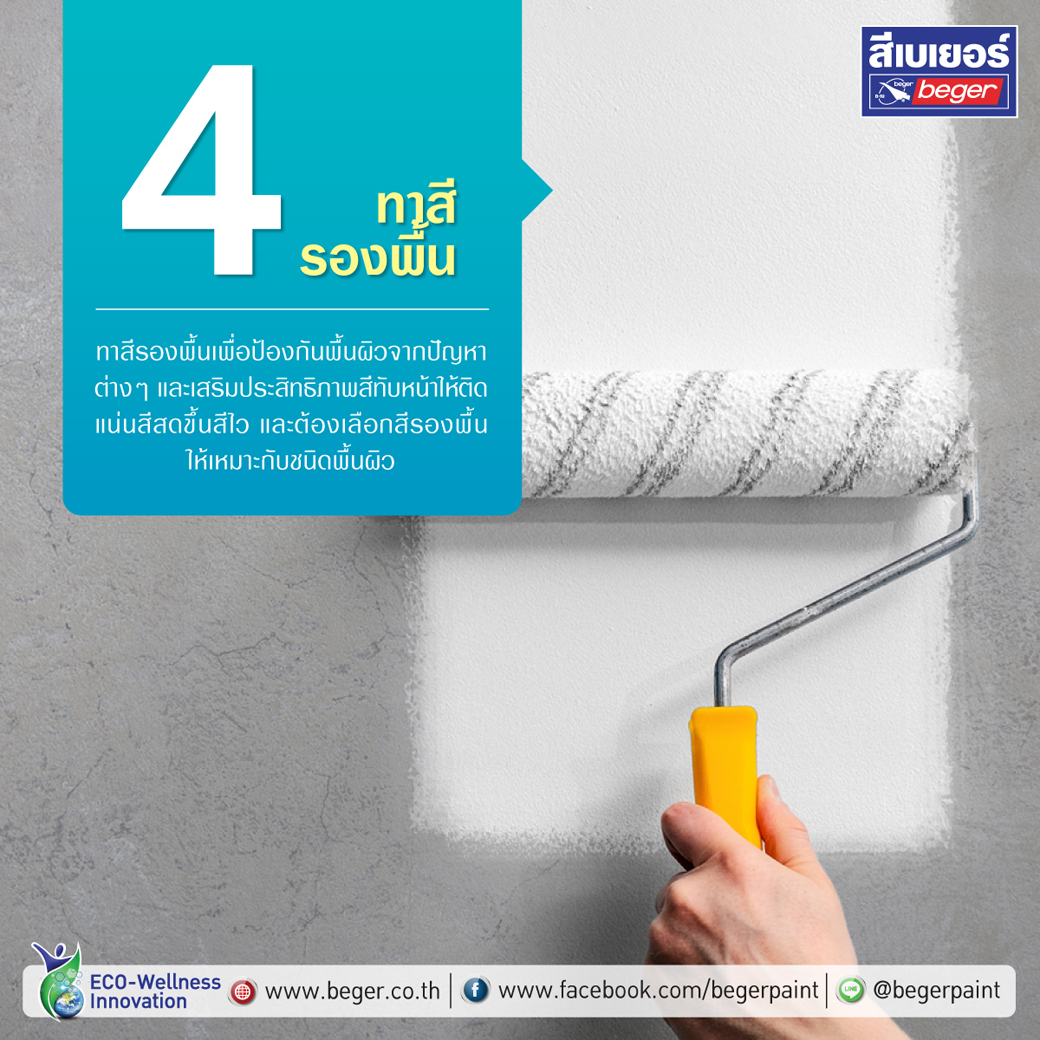
Primer is the first layer of paint applied to the surface before applying the topcoat, helping to prevent potential issues with the surface, such as mold, fading, and peeling, as well as extending the life of the paint to remain fresh and adhered longer.
In cement houses, primers are categorized into old cement primer (for houses older than 5 years), new cement primer (for houses 1 – 3 months old), and fresh cement primer (for surfaces that have just been plastered for 2 – 5 days).
- How to choose the right primer?
As mentioned earlier, the surface of the house affects the choice of products used, especially for primer. If the wrong primer is used, it may reduce the effectiveness of the topcoat. The methods for choosing primer are as follows:
Choose the primer formula, which is usually available in both oil-based and water-based formulas. The oil-based formula provides better penetration and adhesion, but if you want to avoid the smell of paint, it is recommended to consider using the water-based formula.
Choose the primer, which comes in two types: Transparent color suitable for surfaces that have old paint that has been used for a long time, chalking paint, or painted with very low-quality paint before, and in cases where the new topcoat color is close to the original shade. White color suitable for those who want to cover various problems from the original surface, and in cases where the new color shade differs from the original shade.
- Check the condition of the house’s plaster
Old plaster house aged 3-5 years or more should choose old plaster primer such as Beger Primer B-1500, B-1700, B-2500, B-2090
New plaster house aged 1-2 months should choose new plaster primer such as Beger Primer Pro 100, BegerCool All Plus Primer #6000
Fresh plaster house that has just been plastered within 2-5 days should choose multipurpose primer such as Beger Primer B-3100 or B-1900 that can withstand humidity up to 40-75%, which can be applied to all types of plaster surfaces, including new plaster, old plaster, and fresh plaster.
5. Topcoat
is considered the main heart of the entire process because it is the final house paint that will reflect the style of the room or house you want it to be through the colors on the surface. The selection of topcoat color has principles to consider in 5 parts which include
1. Desired shade
2. Water-based or oil-based paint formula
3. Film texture: matte, smooth, or semi-gloss
4. Special properties of the paint
5. Durability, etc.
How to choose a topcoat color?
- Choose the desired shade. You can see this from the color decoration ideas that have more than a thousand shades to choose from, or for maximum accuracy, it is recommended to check from a Fan Deck or color catalog at leading paint stores, which will be more accurate than viewing through a computer screen or mobile screen.
- Choose water-based paint or oil-based paint. Similarly to primer colors, water-based house paints will have a milder scent – are easier to use – and are safer than oil-based formulas. Therefore, if you are concerned about the smell, water-based colors will be more suitable.
- Choose the type of color film The commonly used color film in the market comes in two types: Matt, Sheen slight shadow and Semi-Gloss to showcase a luxurious style and is easier to clean than the matte type (but not suitable for surfaces with blemishes)
- Select other special properties of color Nowadays, colors are not just beautiful but also help protect your home and yourself from various pollutants both inside and outside. For example, BegerCool, a cool house paint that has heat-reflecting properties, helps reduce electricity bills, or BegerShield AirFresh Gold Ion, which has properties that purify the air, kill germs, and eliminate viruses, among others.
- Select the grade of color The grade of paint is measured by its durability, which comes in various grades. The durability starts from 3 to 15 years; the higher the grade, the more durable it is, but it will also be more expensive.

Techniques you should know For those with limited time and looking to reduce costs while completing work as quickly as possible, we recommend BegerCool 2in1 Semi-Gloss, BegerCool 2in1 Exterior Matt, and BegerCool 2in1 Interior Matt, a topcoat paint mixed with a special primer formula that is convenient and ready to use. No need to apply a primer first, no mixing with water, easy to apply, and time-saving. It comes with AEROTECH innovation that helps reduce and reflect heat, enhancing surface protection efficiency. The paint film remains cooler and lasts over 10 years.

6. Collect the work and check for completeness
We have reached the final step. After applying the second coat of paint and leaving it to dry, if using Beger Cool house paint, it will be completely dry in 1 day under normal weather conditions. In case tape was used for protection, remove the tape (before the paint film is fully dry).

It can be seen that painting your own house is something anyone can do, as long as you understand the process steps, choose the right type of paint products, and have a certain level of time and patience. If you can manage all of this, it will help you save quite a bit on labor costs.
If anyone wants to consult about painting, you can chat directly with a technician from Beger through the chat on the website Beger.co.th, via Facebook Beger Paint, or call the Beger Call Center at 02-8155888 extension 3 for free.