
A bollard is a cylindrical steel post installed in front of convenience stores to prevent vehicles from crashing into the store. It is a type of safety device that the engineering community refers to as a “bollard,” which is described by CP as a “store bollard.” This device is designed to protect against vehicles crashing into branch stores to ensure the safety of customers and employees, while also reducing damage to buildings and property. Bollards are installed at branch store entrances where vehicles can park and where there is a risk of vehicles crashing into the store.
What is a bollard and why is it called that?
A bollard is a post firmly anchored to the ground to absorb and withstand the impact from vehicles. The name “bollard” comes from a comparison with an anchor that is dropped to secure a ship in place, but unlike an anchor, a bollard is secured to “land,” meaning it is permanently embedded in a concrete foundation.
In international technical terms, this type of device is called a Bollard or Traffic Bollard, which refers to a short post used to block pathways to control traffic and ensure pedestrian safety. It works by limiting movement and narrowing spaces to reduce speed. Permanently installed models can also prevent crashes by vehicles. In Thai, there are several names for this same object, including เสาสมอบก, เสากันชน, เสากั้นรถ, เสาเหล็กกันกระแทก, and Guard Pole.
What are the benefits of a bollard?
The main benefit of a bollard is to transform “serious accidents” into “repairable damage” by allowing the post to break instead of harming people or buildings.
- Protect lives by preventing out-of-control vehicles or pedal errors from crashing into areas where customers and employees are present.
- Protect building structures and storefront glass The cost of repairing a single post is much less than the combined cost of replacing large glass panes, walls, and shelving.
- Define parking boundaries by indicating to drivers where they should stop, reducing the risk of parking too close to the store.
- Prevent intentional collisions (ram-raid) by stopping the use of vehicles to crash into the store for theft.
- Practical hidden benefits Some people use them as points to chain bicycles, as well as to keep pedestrians away from vehicle lanes.
What are bollards made of?
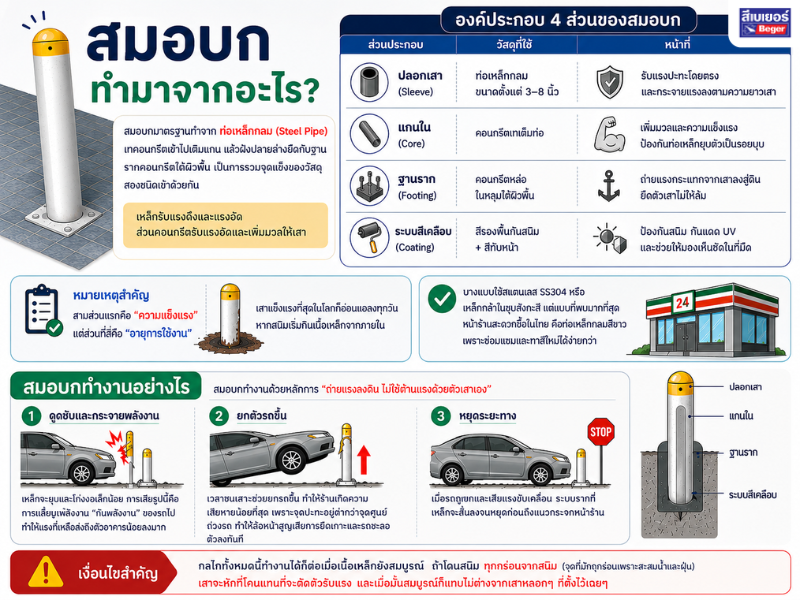
Standard bollards are made from round steel pipes (steel pipe) filled with concrete, with the lower end anchored to a concrete foundation beneath the surface. This combines the strengths of two materials: steel for tensile and bending strength, and concrete for compressive strength and added mass to the post.
The 4 Components of a Pole Anchor
| Components | Materials Used | Functions |
|---|---|---|
| Sleeve (Sleeve) | Round steel pipe, sizes from 3–8 inches | Directly absorbs impact forces and distributes the load along the length of the pole |
| Core (Core) | Concrete filled in the pipe | Increases mass and rigidity, prevents the steel pipe from collapsing into dents |
| Footing (Footing) | Concrete cast in a hole beneath the surface | Transfers impact forces from the pole to the ground, secures the pole head to prevent tipping |
| Coating (Coating) | Rust-resistant primer + topcoat | Prevents rust, protects against UV sunlight, and helps visibility in the dark |
Some models use stainless steel SS304 or galvanized steel. The most commonly found type in convenience stores in Thailand is brightly painted steel pipes, as they are easier to repair and repaint.
How does a bollard work?
A bollard operates on the principle of “transferring force to the ground, not resisting force with the pole itself.” When a vehicle collides, the impact force travels from the point of collision down the pole’s axis, through the inner concrete, to the foundation underground, which has enough mass to absorb the energy.
3 mechanisms that occur in a split second
- Absorbing and distributing energy The steel will crumple and bend slightly. This deformation is the “energy absorption” from the vehicle, significantly reducing the force that reaches the building.
- Lifting the vehicle’s wheels When colliding with the pole, it helps lift the vehicle, causing minimal damage to the store because the point of impact is lower than the vehicle’s center of gravity, resulting in the front wheels losing traction and the vehicle slowing down immediately.
- Stopping distance When the vehicle is lifted and loses propulsion, the remaining braking distance shortens, allowing it to stop before reaching the storefront’s glass.
Important condition: All these mechanisms work only if the steel material is intact. If the base of the pole is corroded by rust (the area that often rusts first due to water and dust accumulation), the pole will break at the base instead of bending to absorb the force, and at that point, the bollard is hardly different from a mere decorative pole.
Why does a bollard rust quickly, and what type of paint should be used?
Bollards rust faster than regular steel work because they are 100% exposed to the outdoors, with no roof cover, and are at eye level, subjected to everything repeatedly every day.
Factors affecting a single pole simultaneously:
- Sunlight and UV rays Cause the paint film to fade, become brittle, and crack, allowing moisture to penetrate the steel.
- Rain and high humidity In the hot and humid climate of Thailand, accelerate the oxidation reaction on the steel surface.
- Dust, soot, and exhaust stains From vehicles idling in front of the store, accumulate as a layer that traps moisture.
- Scratches and light impacts From vehicle bumpers, motorcycle stands, and bicycle chains, are the wounds that rust uses as entry points.
- Water pooling at the base of the pole From the daily cleaning of the storefront
A 2-layer paint system suitable for outdoor steel work in a scaffolding context
In external steel work that must withstand harsh conditions, the accepted approach is not to use a single layer of paint but to separate the functions into a “rust stop layer” and a “weather-resistant layer” as follows
| Layer | Main Function | Example Products | Highlights related to scaffolding directly |
|---|---|---|---|
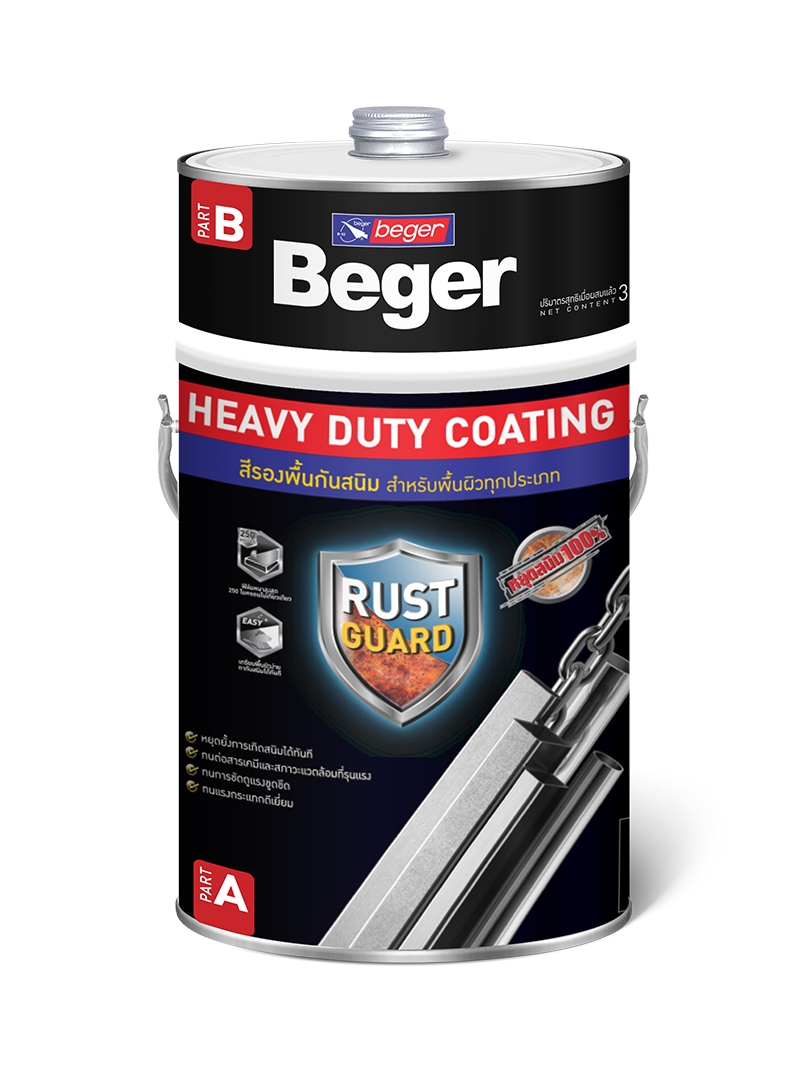
| Layer 1 Primer | Stops rust and adheres to the steel surface | Beger Rust Guard 2-component epoxy paint | Stops rust formation on all types of metal surfaces immediately. Can be applied over steel that has not been completely rusted away, and the paint film is strong yet flexible, making it resistant to scratching, impact, chemicals, and harsh environmental conditions. |
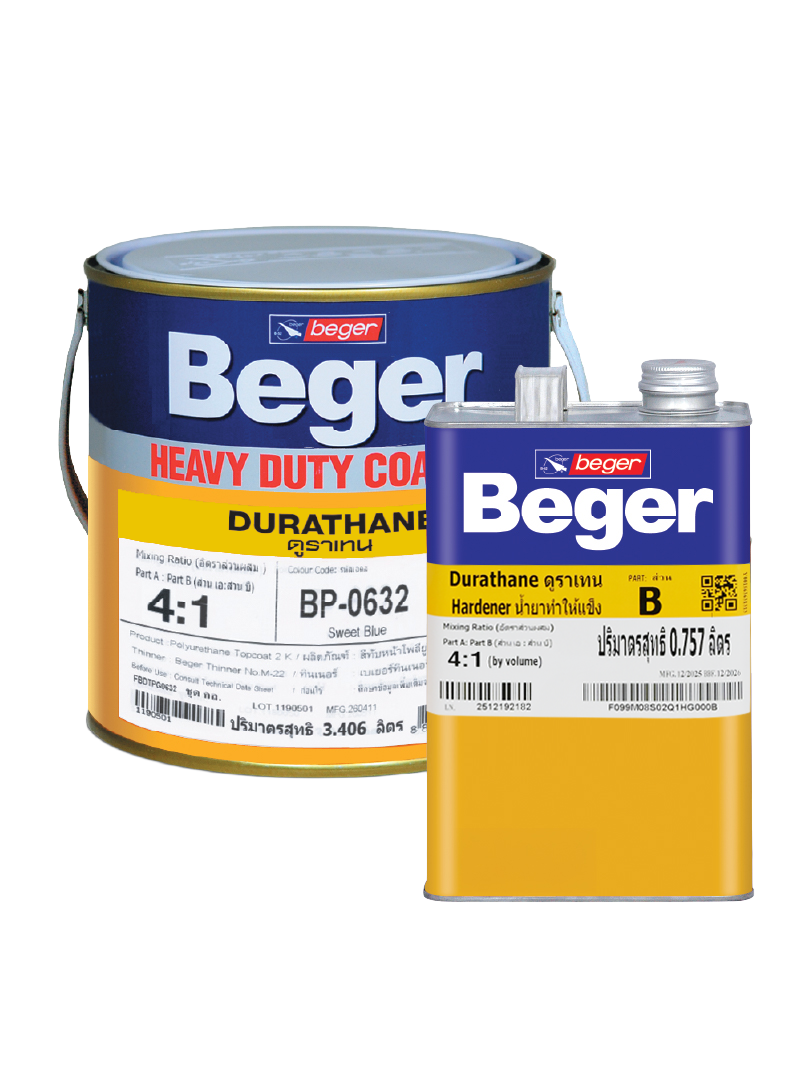
| Layer 2 Topcoat | UV resistant to prevent color fading and corrosion | Beger Durathane 2-component polyurethane | A glossy polyurethane topcoat for outdoor use, resistant to UV rays, corrosion, chemicals, acid and alkali, scratching, and excellent water resistance. |
An interesting point is the usage recommendations for Beger Rust Guard This structure is specifically stated for outdoor work that requires high durability and UV protection, to be coated with Beger Durathane in 1–2 layers, which aligns perfectly with the usage conditions of the scaffolding. Both products belong to the Beger industrial paint group, designed for applications requiring high durability in particular.
How does Graphene Shield Tech change the primer layer?
Graphene Shield Tech is a technology that incorporates graphene (Graphene) which is pure carbon in a hexagonal honeycomb structure just one atom thick into the paint. Graphene is 200 times stronger than steel, possesses strong yet highly flexible properties, distributes force across the surface, and is resistant to corrosion and moisture.
Step-by-step guide to repainting scaffolding
- Prepare the surface For surfaces with old paint, scrape off all loose old paint. Sand with sandpaper or a wire brush, and remove any dirt stains (see detailed surface preparation techniques in the article on how to paint galvanized steel, or use Beger Unisoft 9119 to help strip the old paint).
- Clean grease stains Wipe off all oil and exhaust stains with Beger M-77 thinner because grease stains are the number one cause of paint film peeling.
- Apply rust-proof primer Apply Beger Rust Guard in 1–2 layers, focusing on the base of the poles, which are the most vulnerable areas.
- Apply UV protective topcoat Apply Beger Durathane in 1–2 layers to maintain color and gloss against sun and rain.
- Check every 6 months Look for deep scratches and small rust spots, and touch up immediately. It is cheaper than completely redoing the work.
If it is general steel work that does not require industrial specifications, such as a steel fence or a front door, you can reduce the steps by 2 in 1 steel paint that includes rust-proof primer See real work examples at Techniques for painting steel fences to dry quickly without priming
Product recommendations
|
|
|
FAQ Frequently asked questions about
Q1: Is a bollard the same as a traffic bollard?
A1: Yes, a bollard is the Thai name for the device known internationally as a Bollard or Traffic Bollard, which refers to a short post installed to block and control the movement of vehicles. In Thailand, it is also referred to as a crash post, vehicle barrier, or Guard Pole.
Q2: What is the purpose of the posts in front of 7-Eleven?
A2: They are meant to prevent vehicles from crashing into the store for the safety of customers and staff, and to reduce damage to the building and property. They are installed only at branches where vehicles can park and where there is a risk of vehicles crashing into the store.
Q3: Are bollards hollow or solid inside?
A3: Standard bollards are not hollow; they are steel pipes filled with concrete and anchored to a concrete foundation below the surface, which is why they can withstand impacts without falling over.
Q4: Why are most bollards painted yellow or bright colors?
A4: Bright colors contrast with the road surface and are clearly visible in low light conditions, helping to warn drivers in advance and reduce the chances of collisions from the start. This is the same reason why topcoat colors must be UV resistant and not fade quickly.
Q5: Can I paint over a rusty bollard directly?
A5: You must always remove any loose rust first, but it is not necessary to remove all rust completely. An epoxy primer like Beger Rust Guard can be applied over steel that has not been completely rust-free, reducing the surface preparation steps to just sanding instead of sandblasting.
Conclusion
A bollard is a steel crash post in front of convenience stores that absorbs impact forces instead of the building, utilizing a concrete-filled steel pipe anchored to the foundation to transfer impact forces to the ground and slow down vehicle wheels before reaching the store. It is a device that many people pass by every day without noticing until it is needed. However, the strength of a bollard does not depend on the day it is installed; it depends on whether the steel inside remains intact five years later. Choosing a paint system that effectively stops rust and is UV resistant for a long time is therefore the most cost-effective investment in maintaining the function of this post.