

Many people have encountered problems such as faded house paint, powdery paint, or mold on walls even though they have just painted recently. These issues occur frequently in tropical countries like Thailand and tend to happen more quickly than in temperate countries. The main cause is not only the quality of the paint but also the harsh environmental conditions in the tropical climate which directly affect the deterioration of the paint film on building walls. This article will explain why house paint in hot climates deteriorates quickly and what factors contribute to the destruction of the paint film.
What is paint deterioration?
When paint is applied to a wall, it forms a thin layer called Paint Film which serves to protect the surface from environmental factors such as sunlight, moisture, and rain. Over time, the paint film begins to deteriorate, leading to various problems such as
- Color Fading which occurs due to UV rays damaging the pigments and polymer structure of the paint, causing the color to appear faded.
- Chalking occurs when the paint surface develops a white powder upon contact, due to the deterioration of the paint film structure.
- Cracking happens due to the contraction and expansion of the paint film from changing temperatures.
- Microbial Growth occurs from moisture accumulation on the walls, allowing microorganisms to thrive on the surface.
These problems are commonly found in tropical weather, or in our country, Thailand.
Factors that cause house paint to deteriorate quickly
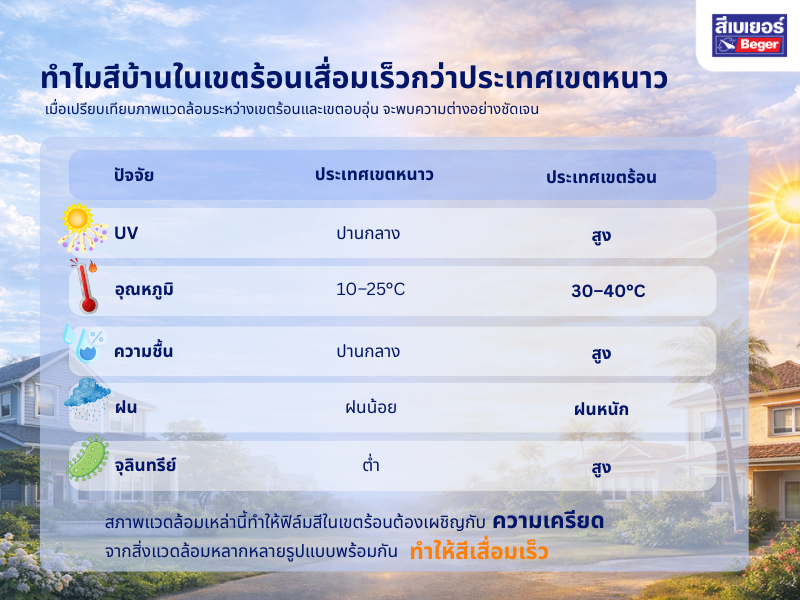
The deterioration of paint does not occur from a single cause but results from multiple factors working together, especially in humid tropical climates.
1. UV rays from sunlight
UV rays are one of the most damaging factors to paint. When the paint film is continuously exposed to UV rays, a process called Photo-oxidation This causes the polymer chains in the paint to break down. The results are
- faded color
- reduced gloss
- brittle paint film
In tropical countries, the intensity of UV radiation can be higher than in temperate areas by 2–3 times
2 Heat and high temperatures
Building walls in hot climates can have temperatures exceeding 35–40°C during the day. The heat accelerates
- chemical reactions in the paint film
- the paint film expands
- the paint structure deteriorates faster
When temperatures fluctuate between day and night, the paint film undergoes repeated expansion and contraction leading to stress in the material and resulting in cracking
3 Humidity in the air
Tropical countries often have relative humidity higher than 60–100%Humidity can penetrate the paint film and trigger a chemical reaction known as hydrolysis. This process causes
- chemical bonds in the paint film to break down
- the paint film weakens
- the paint peels off more easily
Additionally, moisture facilitates the growth of mold and algae on walls.
4 Rain and Water
Rain not only makes walls wet but can also
- wash away paint surfaces
- carry pollutants, causing surface corrosion (acid rain)
When it rains repeatedly, a Wet-Dry Cycle occurs, causing the paint film to expand and contract alternately. In the long run, this may lead to cracking and peeling of the paint film.
5 Microorganisms and Fungi
High humidity weather is conducive to the growth of
- fungi
- moss
- microorganisms
These organisms can adhere to painted surfaces and form a Biofilm and the result is
- walls develop black or green stains
- the paint film deteriorates faster
- the color looks old and dirty
Paint deterioration is not caused by UV alone
Many people think that paint deterioration is solely due to sunlight, but in reality, paint deterioration is caused by multiple factors working together Researchers refer to this phenomenon as Synergistic Environmental Degradation (multiple factors contributing to degradation) such as
- UV
- Heat
- Rain and humidity
- Microorganisms
When these factors occur simultaneously, the deterioration of the paint film will happen faster than if any one factor occurred alone.
Laboratory color testing under real conditions
Modern house paints often undergo laboratory testing, such as
- QUV Test QUV Test is a test of paint durability using UV light tubes that simulate sunlight, along with controlled humidity and condensation, to accelerate the degradation of the paint film in a short period. It is suitable for studying the effects of UV radiation on fading, cracking, and chalking of the paint.
- Xenon Arc Test is a test that simulates sunlight as closely to natural conditions as possible, using Xenon bulbs that provide a light spectrum of UV, Visible, and Infrared, while controlling temperature, humidity, and water spray to mimic real environmental conditions such as sunlight, rain, and heat. It is suitable for assessing the lifespan of paint in real-world usage conditions.
These tests can simulate UV light degradation well, but in the laboratory, various factors are often tested separately, while in real conditions on house walls, factors such as
- sunlight
- heat
- rain and humidity
- pollution
- microorganisms
occur simultaneously. Therefore, laboratory tests cannot fully replicate real conditions.
Paint designed to reduce heat and withstand tropical weather
Considering the factors that cause house paint to deteriorate quickly in tropical climates, such as UV radiation, heat, humidity, and rain, choosing paint designed for such weather is important. Currently, there is heat-reflective paint technology that helps reduce wall surface temperatures, with the effectiveness of this type of paint measured by a value called REI (Reflective Efficiency Index) which indicates the ability to reflect energy from sunlight. The higher the value, the better it helps reduce heat accumulation on the walls and reduces stress on the paint film, which helps extend the lifespan of the paint. One example of paint designed to meet the needs of tropical weather is BegerCool DiamondShield 15 that is used AeroTech innovation with Nano Ceramic Cooling which is developed with sunlight heat reflection technology of up to 97.5%, while also protecting the paint film from UV rays and harsh weather conditions. The key features of this type of paint include
- sunlight heat reflection technology
- helps reduce wall surface temperature
- UV-resistant paint film
- reduces the chances of color fading
- suitable for tropical weather
Choosing the right color for the environment is another factor that helps extend the lifespan of house paint
Why does house paint in hot climates deteriorate quickly?
The deterioration of house paint in tropical weather is caused by several factors working together, including
- high-intensity UV rays
- extreme temperatures
- high humidity
- rain and wet-dry cycles
- microbial growth
When these factors work together, they cause the paint film to deteriorate faster, which is why choosing house paint designed for tropical climates and tested in both laboratory and real conditions is important for the longevity of the paint
FAQ Frequently Asked Questions about house paint in hot weather
Q1: Why does house paint fade quickly when exposed to sunlight?
A1: House paint exposed to strong sunlight for extended periods receives continuous UV rays, which can damage the pigments and polymer structure of the paint film through a process called photo-oxidation, resulting in color fading, reduced gloss, and brittleness of the paint film, especially in tropical countries where UV radiation intensity is higher than in temperate regions.
Q2: What causes house paint to turn to powder?
A2: The condition of paint turning to powder, also known as chalking, occurs due to the deterioration of the paint film when exposed to sunlight, heat, and moisture for long periods. The polymer structure in the paint breaks down, causing pigments to come loose at the surface. When touched, it feels like powder sticking to the hand.
Q3: How long does house paint last?
A3: The lifespan of house paint generally lasts about 7–10 years depending on the quality of the paint, surface preparation, and environmental conditions. If it is an area with intense sunlight, frequent rain, and high humidity, the lifespan of the paint may be shortened.
Q4: Does heat-reflective paint really help keep a house cooler?
A: Heat-reflective paint can indeed reflect heat because it works by reflecting some of the energy from sunlight back out, causing the wall surfaces to absorb less heat, or referred to as REI technology which results in lower temperatures of the walls and heat entering the building, thus helping to keep the house cooler and reducing the load on air conditioning.
Q5: What type of paint should be chosen for houses in hot climates?
A5: The paint suitable for houses in tropical climates should have properties that resist UV radiation, withstand moisture, and help reduce heat from sunlight, such as heat-reflective paint or paint specifically designed for tropical climates. For example, BegerCool DiamondShield 15 which helps reflect heat and protects the paint film from severe weather conditions.