

The summer in Thailand today is not just a season to endure the intense sun, but many areas have a Heat Index so high that it directly affects health. The heat accumulated throughout the day makes homes feel like large ovens. Even with the air conditioning on, it still feels stuffy. Many families thus run their air conditioners continuously from morning until night, leading to rising electricity bills every month, while the air conditioning units have to work hard inevitably. The question many homeowners wonder is Does cool house paint really help reduce the workload of air conditioners?
The answer is “Yes, it helps” and the reason is not just a feeling, but there is clear scientific principle backing it up. Cool house paint can indeed help reduce the workload of air conditioners because it is designed to reflect heat radiation from sunlight, especially infrared (IR) radiation, which is the main cause of hot walls. When walls absorb less heat, the heat that transfers into the house decreases, resulting in lower indoor temperatures as well. When the baseline temperature inside the house is lower, the air conditioner does not have to work as hard or run continuously for as long as before.
Why is the house hot even with the air conditioning on all day?
Many people may have encountered this situation: the air conditioning is set to 25 degrees, but the room is still not as cool as it should be. The main reason often does not come solely from the air conditioner, but from “heat accumulation in the structure of the house.” The walls of the house are areas that receive direct sunlight, especially the west-facing walls in the afternoon. When sunlight hits the walls, heat radiation is absorbed and stored in the building materials. This heat gradually transfers into the house, even after sunset.
Moreover, different materials retain and transfer heat differently. For example, a concrete wall exposed to intense sunlight in the afternoon can have a surface temperature of about 45–50°C, which is clearly higher than the outside air temperature. Meanwhile, materials like steel or metal structures can heat up even more, possibly reaching levels of 60–70°C.
When these materials accumulate heat, they will gradually release heat into the house continuously, causing the inside to remain hot even as the outside begins to cool down.
In such situations, the air conditioner does not just cool, but has to fight against the continuously infiltrating heat, resulting in:
- the compressor working more frequently
- longer operating cycles
- increased energy consumption
- shorter lifespan
The real solution is not to increase the size of the air conditioner, but to reduce the heat at the source.
Heat Index and the unseen effects
Heat Index (Heat Index) It does not only reflect the temperature on the thermometer but is a value that combines “temperature and humidity” together to indicate how hot the body actually feels. When the Heat Index value is high, the body finds it harder to dissipate heat through sweat, leading to symptoms such as fatigue, headaches, palpitations, and in severe cases, the risk of heat stroke. Therefore, if a house accumulates heat, even when indoors, it can still feel uncomfortable, and one may unconsciously rely more on air conditioning.
How does cool house paint work to reduce the air conditioning load?
Sunlight consists of various forms of energy, but the main culprit that makes walls hot is “infrared radiation,” which is direct heat energy. Regular house paints tend to absorb a significant amount of infrared radiation, causing the walls to reach high temperatures, especially in the afternoon when the sun is strongest. In contrast, cool house paint is developed with Solar Reflective Technology that helps reflect some of the heat energy back out before it is absorbed into the walls.
The results are:
- Wall surface temperature decreases
- Heat accumulation reduces
- Heat transfer into the house decreases
- Air conditioning operates more lightly naturally
The reduction of the air conditioning load thus occurs from controlling heat energy at the wall surface level.
A comparative example for clearer visualization
Imagine two houses located next to each other, receiving sunlight at the same time. The first house uses regular paint, while the second house uses cool house paint. In the afternoon, the walls of the first house will be extremely hot to the touch, while the other house will have a lower wall surface temperature. As evening approaches, the first house continues to release heat into the interior, but the house using cool house paint will have reduced heat accumulation. This small difference at the wall surface significantly affects the long-term operation of the air conditioning.
Does cool house paint really help reduce electricity bills?
While the results depend on various factors such as house orientation, insulation, and usage behavior, in principle, when the air conditioning operates less, energy consumption will also decrease. A house that effectively reduces heat accumulation will maintain a more stable internal temperature, leading to reduced compressor cycles, which impacts electricity bills in the long run – click to see reviews from users of cool house paint products.
Can dark colors be used as cool house paint?
The common understanding often assumes that dark colors must always be hotter, which is true for regular paints. However, if it is a dark color with heat reflective technology, it can reduce heat accumulation better than standard dark colors. Therefore, the choice of color does not need to be limited to light tones if the product has suitable properties.
Sustainable solutions for hot houses in summer
Although cool house paint helps reduce the air conditioning load, a comprehensive solution should be implemented alongside other measures, such as:
- Installing insulation under the roof
- Adding eaves or awnings to reduce direct sunlight
- Using light-filtering glass
- Planting trees to create shade
- Organizing proper ventilation systems under the roof
When managing walls, roofs, and openings together, the house will cool down noticeably, and the air conditioning will operate more efficiently.
In an era where the heat index is continuously rising, reducing the air conditioning load is not just about saving electricity bills but also about designing homes to cope with changing weather conditions. Cool house paint is therefore not just an aesthetic choice but a means of managing heat energy from the source, helping to make homes more comfortable, reducing the workload of air conditioning, and increasing long-term value.
Product Recommendations
|
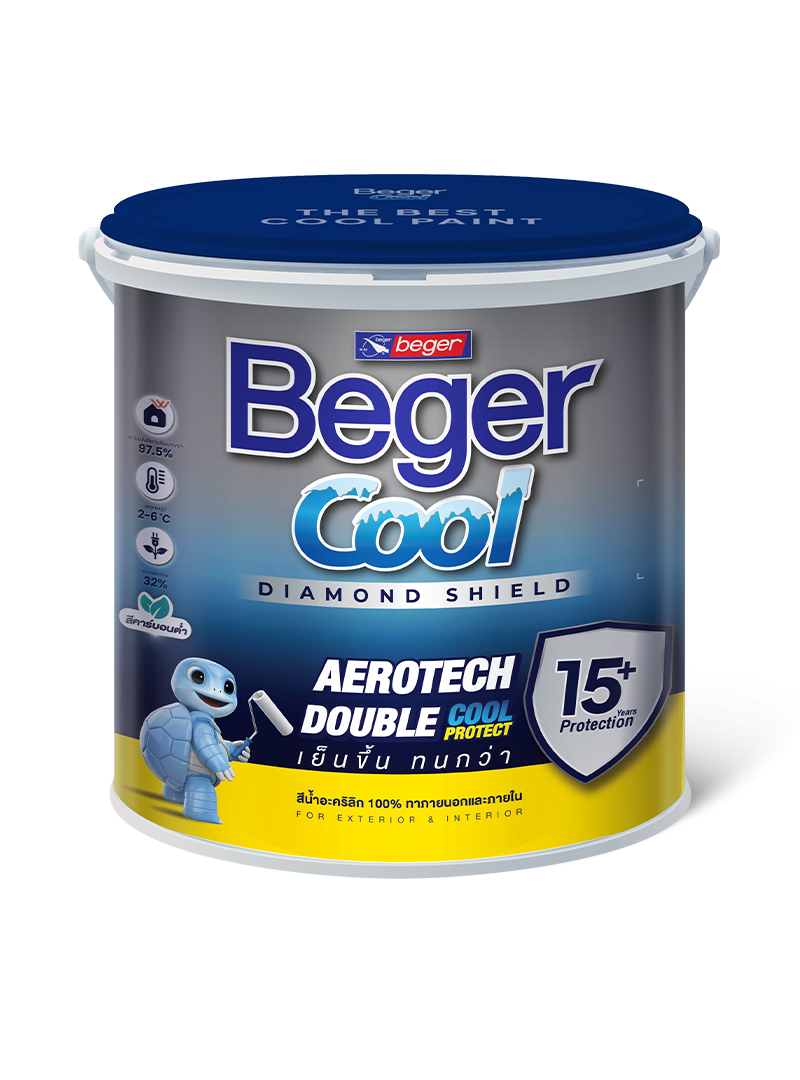
BegerCool DiamondShield 15 |
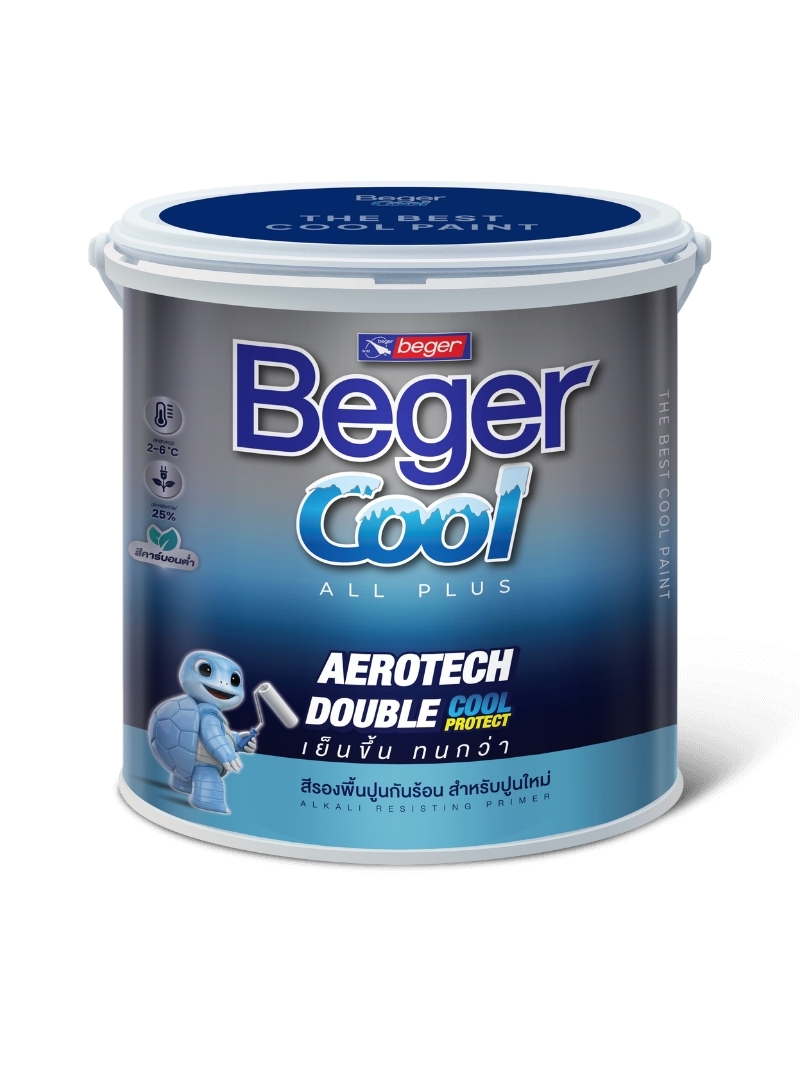
BegerCool All Plus Primer #6000 |
BegerCool INSULATING Primer #9000 |
FAQ Frequently Asked Questions about Cool House Paint
Q1: How many degrees can cool house paint reduce the temperature?
A1: It depends on the environment, but it can significantly reduce wall surface temperature compared to regular paint.
Q2: Is it enough to apply only on the exterior?
A2: The exterior is the most important, as it is the area that receives direct sunlight.
Q3: Do I need to paint the entire house?
A3: Walls that are exposed to intense sunlight, such as those facing west, should be prioritized.
Q4: What should I use as a primer with BegerCool DiamondShield 15?
A4: It is recommended to use it with BegerCool All Plus Primer #6000 for heat resistance, and if you want enhanced performance in preventing and repairing cracks, it is advisable to use BegerCool INSULATING Primer #9000, which provides a thicker and more flexible paint film.