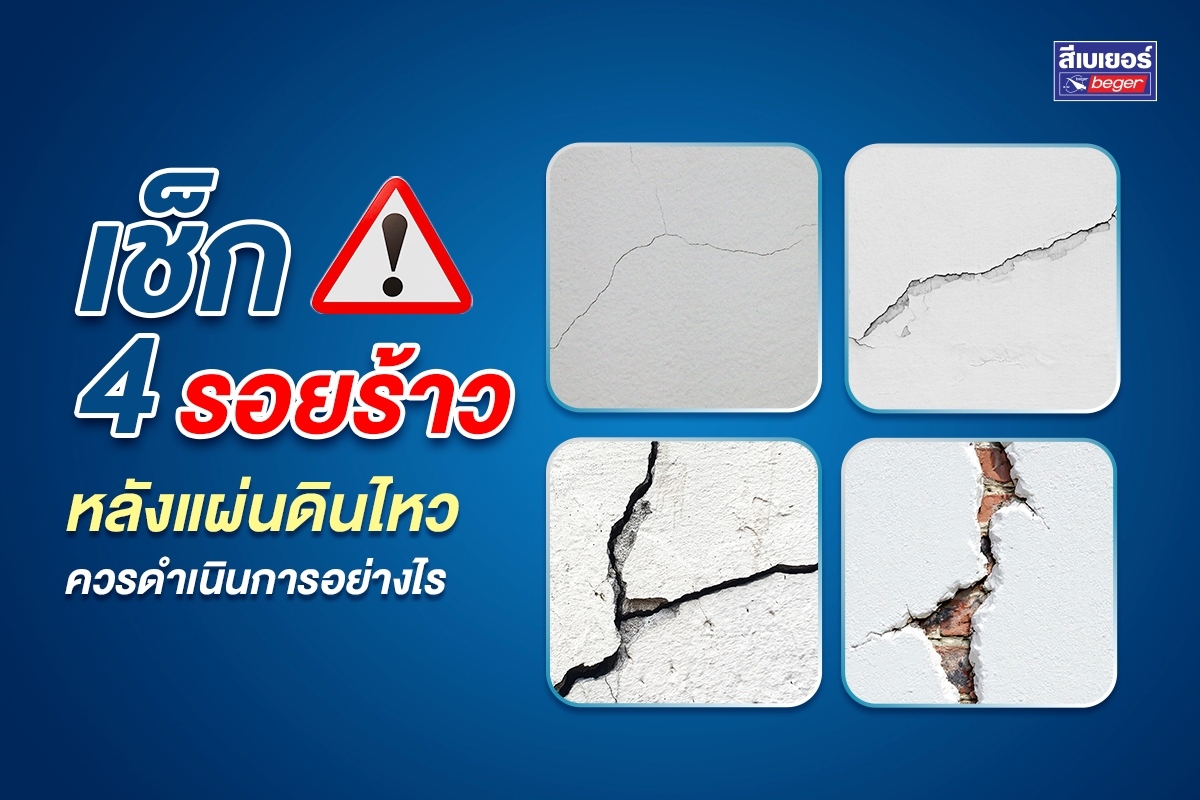
Damage is a common consequence of earthquakes. The stronger the earthquake, the more damage it can cause. One of the signs of damage iscracks after the earthquakethat appear on the walls or structures of buildings and homes. Are these cracks dangerous? Can they be repaired? We have the answers for you.
Cracks after an earthquake: Are they a sign that the building is not strong enough?
Many may wonder why newly constructed buildings can have cracks, while older buildings or those built a long time ago do not show any cracks. Does this mean that newly constructed buildings are not strong and do not meet standards?
First, we need to discuss modern building design standards. With the enforcement of these standards, buildings constructed since 2007 have been designed to be ductile rather than just strong like older buildings. The difference between ductility and strength is:
Old buildings (strength)
can withstand less seismic force. Strength comes with brittleness; when the building accumulates seismic forces beyond its limits, it can collapse suddenly without warning.
New buildings (ductility)
can absorb more seismic force. The building can sway, bend, and deform, dissipating seismic energy as movement. Cracks may occur as a warning sign before collapse.
It can be seen that cracks after an earthquake do not indicate the strength of the building but are a sign of damage and a warning for people to evacuate for safety.
In cases where a new building has no cracks, it may be considered that 1) the building is very strong, so the seismic vibrations cannot cause damage, or 2) the design of the building does not meet ductility standards.
For everyone’s safety, it is advisable to consult a structural engineer to inspect the building before use, especially cracks after an earthquake that occur around columns or beams.
Are cracks after an earthquake dangerous?
Cracks after an earthquake are not necessarily dangerous in every case. If cracks, as well as issues like falling plaster or loose tiles, do not occur in structural areas, they are considered not dangerous and not abnormal, as these construction materials are often designed to move to reduce vibrations.
However, if cracks occur in structural areas, especially if they are clear or large enough to expose the internal reinforcement, it is necessary to have an engineer or expert assess the damage before repairs.
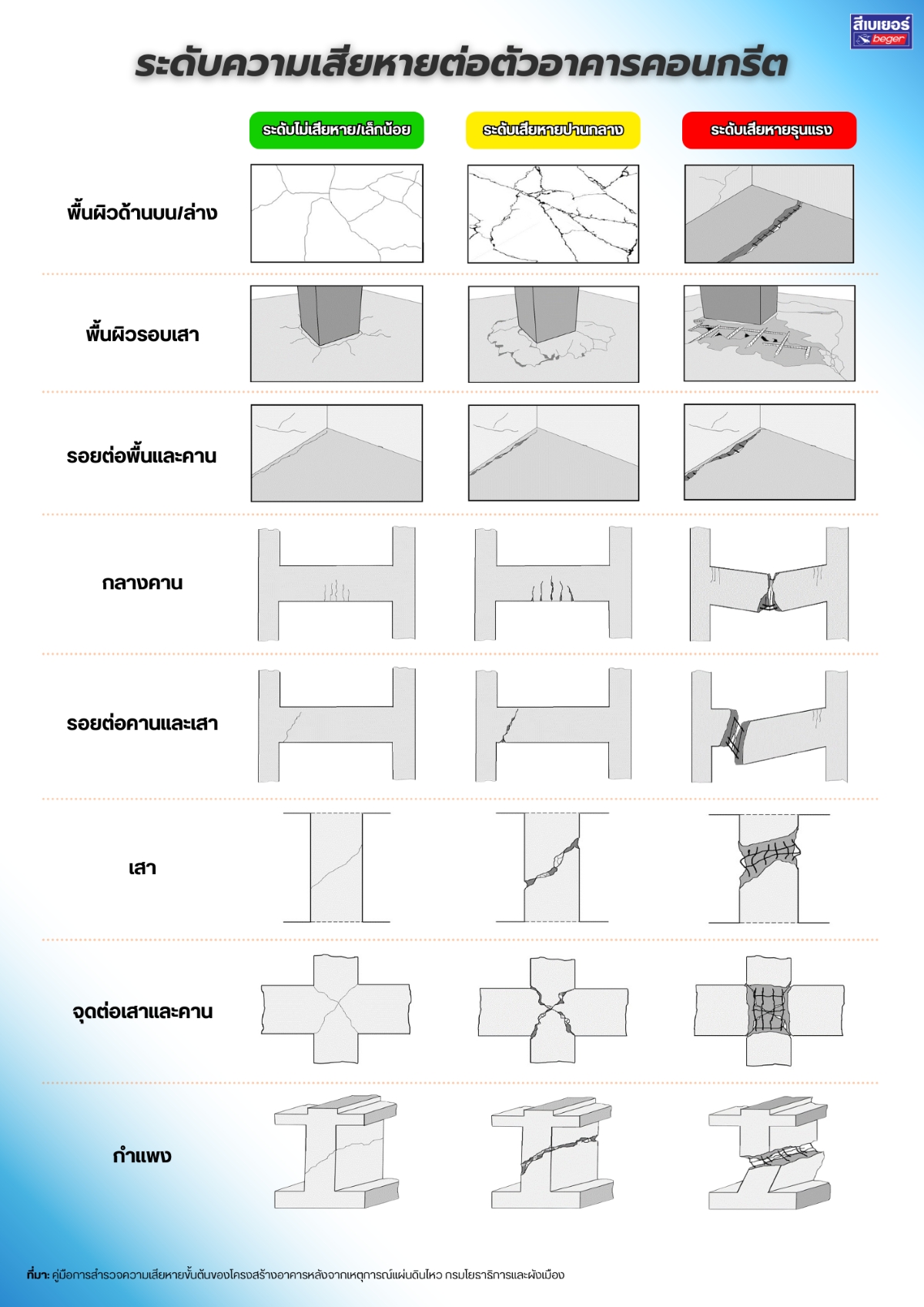
Initially, the Department of Public Works and Town & Country Planning assesses the preliminary damage to buildings by categorizing the severity into 3 color levels:
| Color Level | Severity Level | Possible Damage | Recommendations for Building Use |
| Green |
Level that is not dangerousNo damage or minor damage |
|
The building can be used as normal |
| Yellow (Yellow) |
Moderate levelShould be repaired and inspected by a professional before using the building |
|
The building can be used conditionally (The building can be used partially or fully; caution should be taken regarding falling debris, and the building should be thoroughly inspected again) |
| Red (Red) |
Danger levelInspection by a professional is necessary before using the building |
|
Do not use the building (The building is heavily damaged and may risk collapse, or the condition of the building may pose a life-threatening danger) |
4 Can earthquake cracks be repaired?
Earthquake cracks can be categorized into several types, depending on their location and size. Knowing what type of crack it is helps in getting more targeted repairs, enhancing the safety of the building after an earthquake as follows:
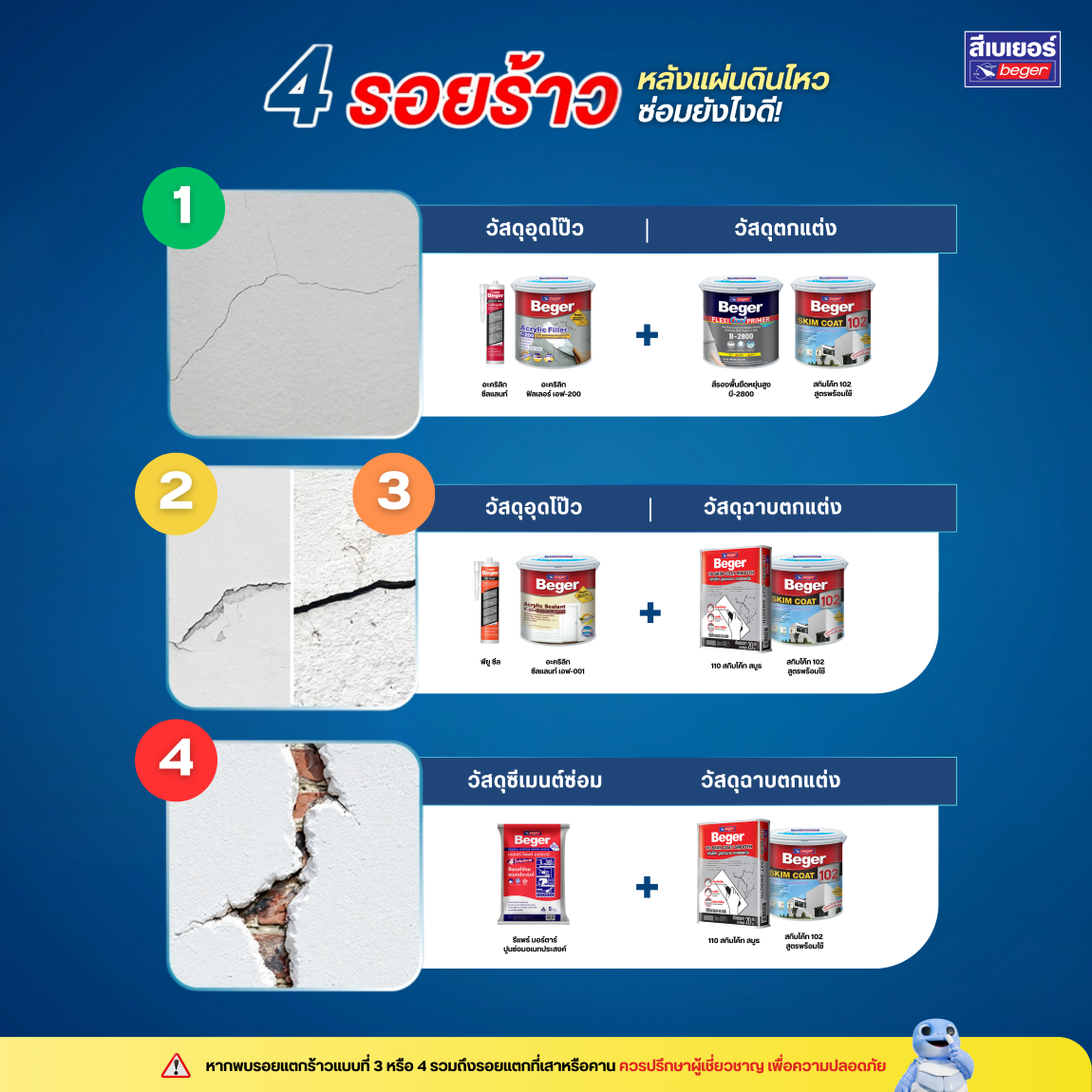
1. Hairline cracks
Cracks smaller than 1 millimeter on the plaster surface. Generally, they are not dangerous to the structure but should be repaired by patching or repainting to prevent future issues.
This type of crack is not concerning and can be repaired by yourself with the following products:
- Beger Acrylic Seal / Beger Acrylic Filler F-200
- Beger 110 SKIM COAT Smooth / Beger Skim Coat 102 (ready to use)
- Beger primer and topcoat system
2. Plaster cracks
Cracks deeper than fine cracks, approximately 3-10 millimeters, are present only in the plaster layer. They are caused by vibrations that may cause structural movement. Repairs should be made and monitoring should continue for further observation.
This type of crack is not concerning and can be repaired by yourself using the following products:
- Beger PU Seal / Beger Acrylic Sealant F-001
- Beger 110 SKIM COAT Smooth / Beger Skim Coat 102 (ready to use)
- Beger primer and topcoat system
3. Diagonal cracks on the wall
Diagonal cracks at angles of 30-45 degrees, both vertical and horizontal, with a width of approximately 3-10 millimeters, occurring in walls, frames, and corners of doors or windows, are caused by shear forces acting on the structure. It is important to inspect and rectify these issues promptly due to moderate danger and potential structural problems.
This type of crack should be monitored. In some cases, it can be repaired by yourself; in other cases, it should be repaired by a professional using the following products:
- Beger PU Seal / Beger Acrylic Sealant F-001
- Beger 110 SKIM COAT Smooth / Beger Skim Coat 102 (ready to use)
- Beger primer and topcoat system
*In cases of grooves deeper than 5-10 millimeters, it is recommended to use a backing rod in the first layer.
4. Structural cracks
Cracks wider than 10 millimeters, deep enough to see the reinforcing steel, or cracks throughout the thickness of the wall, are caused by the settling of the foundation. This affects the stability and strength, posing a high level of danger. It is necessary to evacuate the area immediately and conduct an inspection and urgent repairs by a structural engineer for safety.
This type of crack cannot be repaired by yourself in all cases. The solution product is as follows:
- Beger Repair Mortar
- Beger 110 SKIM COAT Smooth / Beger Skim Coat 102 (ready to use)
- Beger primer and topcoat system

In addition to cracks after an earthquake, it is recommended to thoroughly check the ceiling and tiles as well. Although the external condition of the materials may appear normal, there may actually be movement, detachment, or damage that is not visible. Building users may therefore be at risk of injury.
If detected For cracks of type 3 or 4, including cracks in columns or beams, it is advisable to consult an expert and expedite evacuation. For your own safety, you may consult an expert from Beger at Line: @BegerPaint or seek assistance from government agencies such as Traffy Fondue (Line: @traffyfondue) or the Department of Public Works and Town & Country Planning hotline at 1531.
References:
- Initial Damage Assessment Guide for Building Structures After an Earthquake | Department of Public Works and Town & Country Planning
- How to Know if the Condo We Live In is Still Strong and Safe After the Biggest Earthquake in Bangkok in 100 Years | BBC Thai