
Washable wall paint: a solution for managing stains in homes with children. How to choose it wisely? Anyone with small children at home will be familiar with this scenario: you come home one day to find a long streak of colored pencil on the living room wall, fingerprints from snacks on the corner of the sofa, or milk spills that have left stains that won’t come off no matter how much you wipe. These issues do not mean you are not taking care of your home; rather, they often stem from choosing interior paint that was not designed to be washable from the start. This article will explore why homes with children need to prioritize washable wall paint, how to properly clean different types of stains without leaving marks on the walls, and what to look for when purchasing so you don’t have to repaint every year while achieving walls that are both clean and safe for everyone in the home.
Why do homes with children need washable wall paint?
Children learn about the world through touch, making the walls of the home both a canvas for drawing, a place to lean against, and a support point while learning to walk. These behaviors are natural parts of development. What we can truly control is not the child, but the choice of wall surfaces that can handle these marks. Many standard interior paints have porous film that absorbs stains, and when wiped vigorously, they create scuff marks that worsen the situation. In contrast, paints designed to be washable have a tighter film, allowing stains to sit on the surface and be easily wiped away without damaging the paint itself. The hidden cost that many overlook is the expense of repainting. If the walls are marked to the point where you need to touch up specific areas or repaint the entire room every one to two years, when you factor in the cost of paint, labor, and the hassle of cleaning up, it often ends up being more expensive than investing in washable paint from the start.
Common stains in homes with children and how to clean them correctly
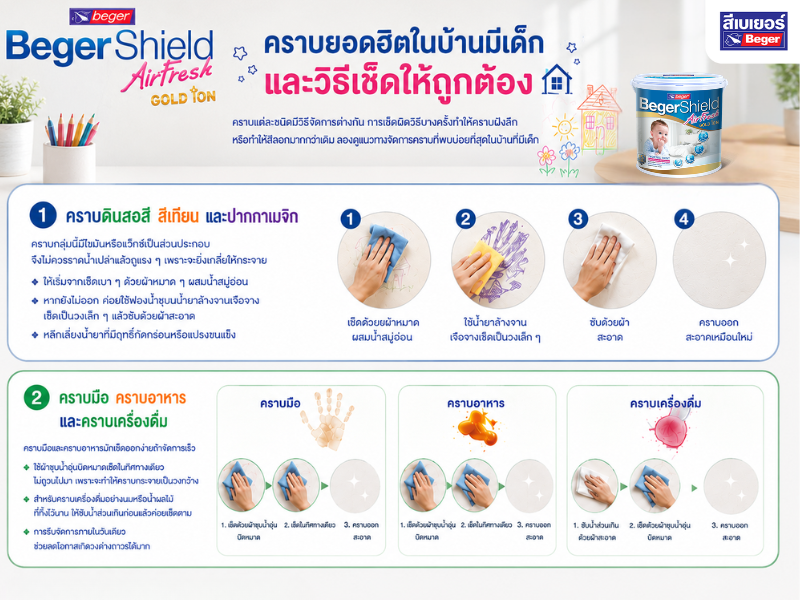
Each type of stain requires a different cleaning approach. Incorrect cleaning methods can sometimes cause stains to set deeper or make the paint peel more than before. Here are some guidelines for dealing with the most common stains in homes with children.
- Crayon, wax crayon, and magic marker stains
These stains contain fats or wax, so you should not apply plain water and scrub hard, as this will only spread the stain. Start by gently wiping with a damp cloth mixed with mild soap. If the stain persists, use a soft sponge dipped in diluted dish soap to wipe in small circles, then blot with a clean cloth. Avoid abrasive cleaners or hard brushes that can scratch the paint. - Handprints, food stains, and beverage stains
Handprints and food stains are usually easy to wipe off if addressed quickly. Use a cloth dampened with warm water, wrung out, and wipe in one direction. Do not rub back and forth, as this will spread the stain. For beverage stains like milk or juice that have been left for a while, blot up excess liquid first, then wipe. Addressing stains on the same day significantly reduces the chances of permanent marks.
Techniques for cleaning that won’t damage the paint film
- Always test cleaning solutions in an inconspicuous area first to ensure the paint does not fade or peel.
- Use soft cloths or sponges; avoid Scotch-Brite pads and hard brushes that can scratch the paint.
- Wipe gently and blot dry; do not leave the walls damp for long.
- Address stains as quickly as possible; fresh stains are always easier to clean than dried ones.
What does “washable” mean? Know before you buy.
The term washable wall paint appears on the labels of almost every brand, but the actual durability varies greatly. The most comparable figure is the number of scrubs (scrub resistance), which is tested by repeatedly rubbing the same spot until the paint begins to wear off. The higher the number, the more scrubs the paint can withstand. Standard interior paints may last for tens of thousands of scrubs, while some premium-grade paints can last for hundreds of thousands of scrubs. This difference directly reflects how long the walls can handle cleaning in real life before showing wear. When comparing products, you should look at the number of scrubs alongside the testing conditions, not just the term washable on the box.
Semi-gloss vs. matte finish: which is better for cleaning?
The type of paint film directly affects cleaning. Generally, glossier finishes have a tighter surface and are slightly easier to wipe clean, while matte finishes better conceal imperfections in the walls but are harder to maintain in frequently touched areas. A simple pairing principle is as follows:
- Semi-gloss is suitable for areas that frequently get stained and need regular cleaning, such as hallways, walls near dining tables, and playrooms.
- Matte finish is suitable for bedrooms or showcase walls that emphasize smooth aesthetics and are not heavily touched every day.
Some interior paint models are available in both types of film within the same product, allowing for perfect matching for each room without the need to change brands.
Cleaning alone is not enough; it must also be safe for children.
Easy-to-clean walls are only half of the equation. The other equally important half is what is in the paint and the odors that linger in the room, especially in homes with young children who breathe more rapidly than adults and spend more time close to surfaces.
Low-odor house paint, ready to move in quickly.
The pungent smell of most paints comes from volatile substances. When choosing a water-based paint for home use with a mild scent, it helps reduce discomfort during and after painting, allowing the family to return to the room more quickly without having to endure the smell for several days. This is especially important for homes with young children or elderly individuals who are sensitive to odors.
Safe colors and colors safe for mothers and children
The term “safe color” should be based on what is not present in the paint. A good paint should not contain mercury and lead, and Zero VOCs or have Volatile Organic Compounds (VOCs) This is the reason why many brands emphasize the term “safe colors for mothers and children.” This group comes into contact with walls and breathes the air in the room more than others. A simple way to check is to read the label and look for environmental or air quality certification, as well as the Thai Industrial Standards (TIS) for emulsion paint. These certifications help confirm that the advertising claims on the box are backed by actual testing, not just marketing messages.
Examples of interior paint colors that meet both washability and safety requirements.
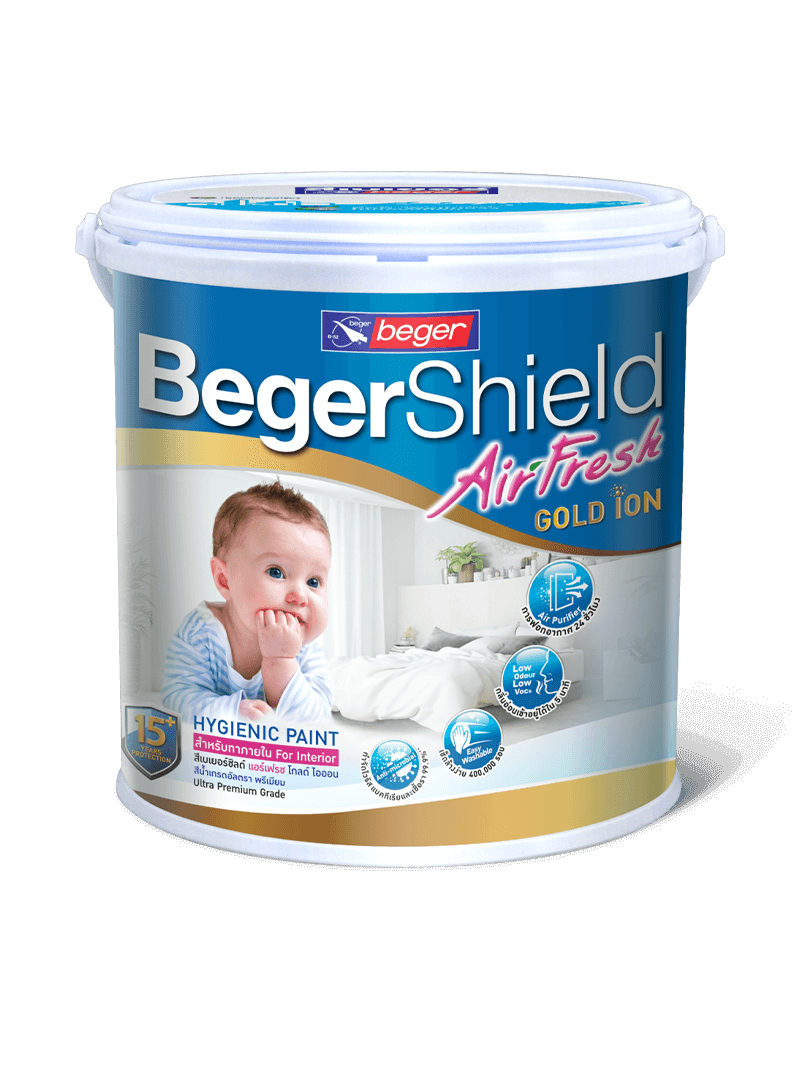
For example, if we are to cite a color that combines all the above properties in one model. BegerShield AirFresh Gold Ion It is an interior paint with Zero VOCs, low odor, free from mercury, lead, and hazardous volatile organic compounds (VOCs). Its highlight is the paint film that withstands scrubbing up to approximately 450,000 times based on tests from the Beger laboratory, which directly addresses the issue of stain wiping in homes with children.
In addition to the cleaning aspect, the product is designed with a 3D cleanliness concept, including the inhibition of germs on surfaces using Gold Ion technology, air purification to reduce pollutants such as formaldehyde, and a film surface that allows for easy cleaning. It is a water-based formula with a mild scent, free from mercury and lead, and it specifies that it can be occupied within 5 minutes after the paint dries. In terms of credibility, this product has won the Most Innovative Best Interior Paint award from theAsianparent Awards 2023 and has certifications for air quality and volatile organic compound emissions from international institutions. It is available in both semi-gloss and matte finishes, allowing it to be paired with each room according to its use. It is always recommended to compare specifications with your budget and the actual usage characteristics of your home before making a decision.
Product Recommendations
FAQ Frequently Asked Questions about Washable House Paint
Q1: Are all types of interior paint washable?
A: Not all types; many models can only wipe off superficial stains, but they will scratch if wiped hard or if they come into contact with deep stains. You should refer to the number of scrubbing cycles on the label as a comparison criterion.
Q2: Which is easier to clean, semi-gloss or matte finish?
A2: Generally, glossy films are slightly easier to wipe off stains, making them suitable for areas that are frequently touched. On the other hand, matte films are suitable for rooms that emphasize smoothness and are not wiped daily.
Q3: How to determine safe colors for mothers and children?
A3: Based on the absence of mercury and lead or Zero VOCs, it has a mild scent and is certified for environmental standards or air quality.
A home with children doesn’t have to succumb to stains on the walls. By understanding two main points, you can take care of your home much more easily: 1. Choose washable interior paint by looking at the number of scrubs and matching the type of semi-gloss or matte finish suitable for each room. 2. Handle stains correctly and quickly, while also selecting paints with low odor that are safe for mothers and children. When you have interior paint that is both easy to clean and safe, your home’s walls will remain beautiful and easy to maintain for a long time. Try comparing these criteria with the paint you are considering, and choose the option that best fits both your budget and your family’s lifestyle.