
GoalsNet Zeroby 2050 has prompted many organizations to adapt in preparation for the significant changes that are certainly approaching in the near future. One area that has garnered much attention in the construction industry is the new era of construction that focuses on carbon reduction and the design of green buildings (Green Building), which includes 4 key components:Designs – Rules – Tools – Materialthat will lead us to the Net Zero goal. Let’s study together!
1. Designs – Eco-friendly Design
Focus on designing and selecting materials that meet high standards and have lowcarbon(Embodied Carbon) emissions to ensure a sustainable material sourcing process. Organizations should engage closely in collaborative work.
Change the perspective on renovation to be more environmentally conscious and reduce material usage by avoiding demolition, considering the climate characteristics, and choosing locally abundant materials. Improve and redesign buildings to ensure sustainability while reducing carbon emissions. Design spaces to accommodate diverse uses (Mix-used) for optimal space utilization, reducing unnecessary construction and material use.
Additionally, the use of computer technology in design helps designers and clients visualize the same model without wasting real resources, reducing the use of materials like concrete while maintaining structural strength, minimizing environmental impact, and reducing on-site activities and waste that often release significant amounts of carbon.
2. Rules – Standards and Regulations
Green Building Certification is a long-established standard in Thailand that not only enhances the energy efficiency of buildings but also adds value to the surrounding community and environment. Key components used to measure the effectiveness of green building standards include:
- Buildings must be certified through third-party verification to guarantee environmental friendliness transparently, avoiding greenwashing.
- The energy efficiency of the building must be at least 20% better than the national average for energy savings and reduced environmental impact.
- Awareness of the environmental and community impacts surrounding the building, facilitating effective, continuous, and easier monitoring and improvement.
Carbon Tax is also one of the factors driving businesses to be environmentally conscious and responsible for carbon emissions from their production processes, enhancing the potential for producing goods more efficiently while emitting less carbon to drive the economy both domestically and internationally.
Financial institutions can use these two criteria to consider funding approvals through five main components: Human Performance, Resources, Social Value, and Risk & Resilience for sustainability in commercial real estate.
3. Tools – AI Technology
Building Information Modeling (BIM) is a process that aids in the design and digital modeling of buildings from inception to demolition. BIM provides essential data that simplifies the design of structures, production processes, and construction, forecasting material quantities required, carbon emissions, and waste generated from demolition or construction, facilitating long-term sustainable development.
The advent of AI technology also plays a role in design (Generative Design) by generating various design options that can be compared in terms of efficiency and risk to find the most suitable design while maximizing carbon reduction.
Such as the applicationPaint CO2CalCalculate EmissionsGreenhouse Gas(CO2 Emission) and the energy-saving values from the paint for buildings by Beger have been developed to help consumers, designers, and partners visualize carbon quantities, electricity usage, indoor temperature levels, and environmental outcomes more easily. This promotes sustainable construction as well.
4. Materials – Low Carbon Paints
Construction businesses worldwide are continuously developing low carbon-emitting construction materials, which is a significant step towards sustainable development. Since over 37% of carbon dioxide emissions come from the building and construction sector, producing or using low carbon-emitting construction materials is a crucial foundation for making eco-friendly design and construction a reality.
Currently, paint businesses like Beger have reduced carbon emissions by over 336,636,000 kg CO2 eq. by focusing on the selection of raw materials from low carbon manufacturers, developing low carbon paints, planning delivery routes using AI, and choosing to use EV vehicles for product distribution. In the downstream process, there are also methods for Reuse & Recycle of paint buckets appropriately, as well as Recovery to treat paint water for beneficial reuse, resulting inlow carbon paintsreaching consumers.
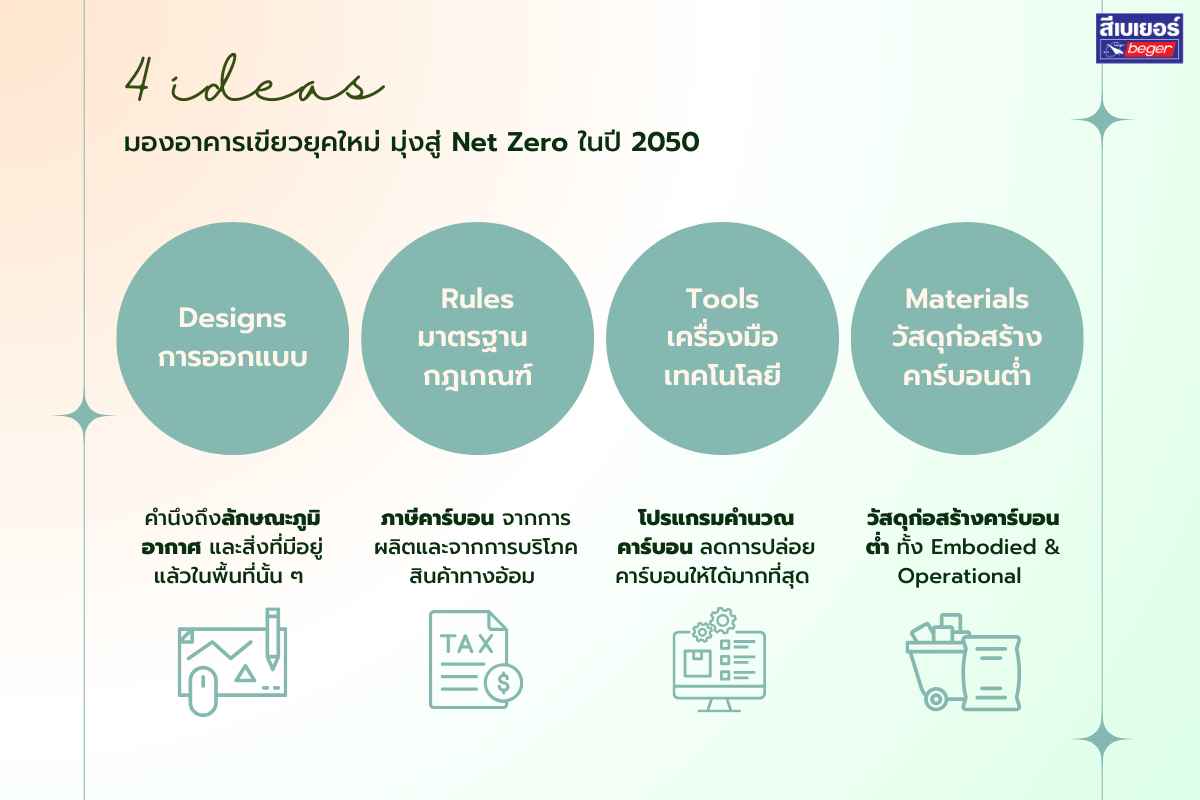
Green Buildings with 4 Components Designs – Rules – Tools – Materials is a new concept that creates significant ripples, prompting many organizations in the business sector to adapt and change their operations to develop in line with the times, where all sectors must pay more attention to the world and the environment, not just for the survival of companies but to reduce the impact on this planet and ensure its sustainability.