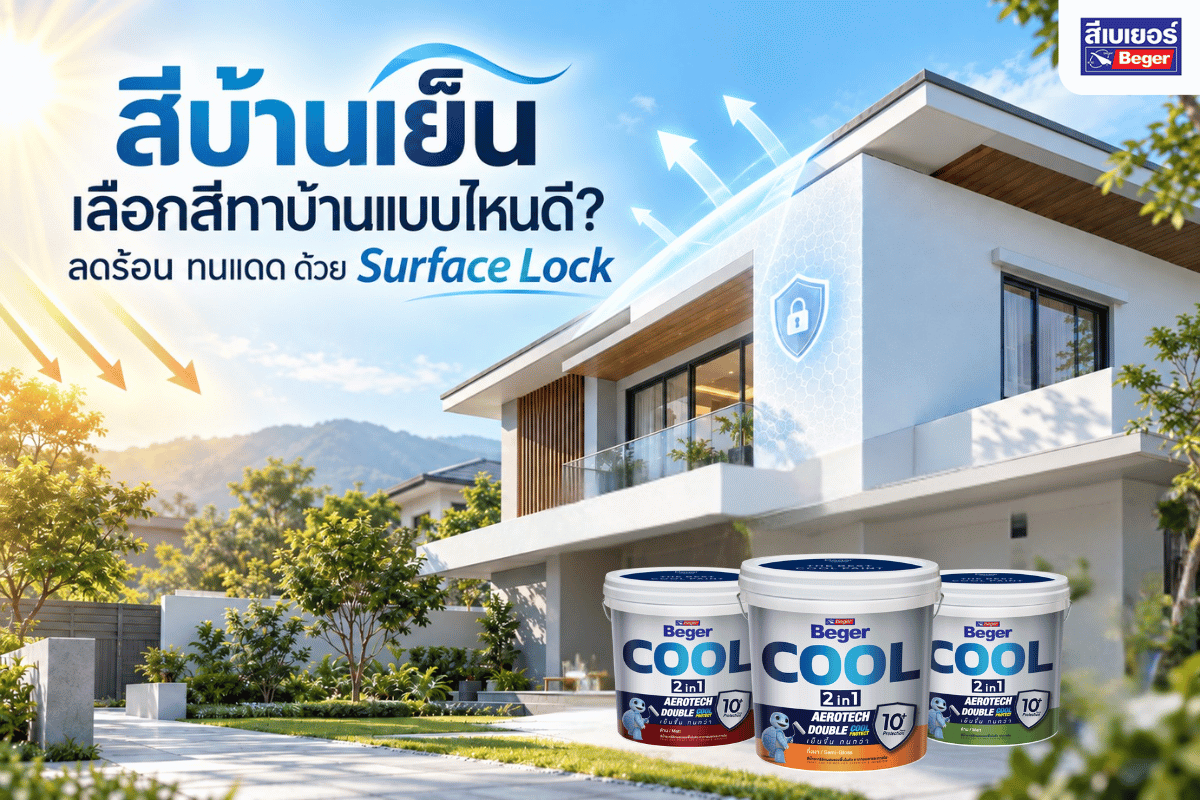
Extreme heat, strong sunlight, and walls that accumulate heat throughout the day are problems many homes in Thailand face, especially those with west-facing walls that receive sunlight in the afternoon. Choosing a Cool House Color or Cool Paint that has heat-reflective properties is one way to help reduce heat accumulation on building surfaces while also enhancing the durability of house walls in the long term.
What type of paint helps keep a house cool? Does it have to be only light colors? And does heat-reflective paint really save on electricity bills?
The answer is You should choose paint that has properties to reflect solar radiation, has weather-resistant film, and adheres well to surfaces. Because the effectiveness of cool house paint does not depend solely on the shade of color but also relates to the technology of the paint material, the condition of the walls, and the appropriate painting system.
What is Cool House Paint? How does it help reduce heat in the house?
Cool House Paint (Cool Paint) is a type of building paint designed to have properties that reflect energy from sunlight, helping to reduce heat absorption on wall surfaces. When the surface accumulates less heat, it may help reduce the heat that transfers into the house.
The working principle of cool house paint involves three key factors:
- Solar Reflectance helps reduce the solar energy absorbed by the walls.
- Heat Transfer Reduction When the surface absorbs less energy, the heat that passes into the building may also decrease.
- Paint Film Technology Certain specific formulations of some paint types enhance heat management properties and durability.
However, cool house paint does not replace all thermal insulation because the indoor temperature still depends on sun direction, roofing, ventilation, and construction materials. For those interested in a deeper understanding of the working principles, you can read more about what REI is, and the principles of reflection, emission, and resistance to heat.
What type of paint should you choose to keep your house cool? Check these 4 properties before deciding.
1. Choose heat-reflective paint with clear testing data.
Cool house paint should have information about its performance in reflecting solar radiation, especially near-infrared radiation, which is part of solar energy. Before purchasing, consider the reflectance values, testing methods, and shades used in the tests, as each shade may have different energy reflection capabilities. Examples of related technologies include Ceramic Cooling and AeroTech technology, which enhance heat management and are innovations used in the BEGER paint system.
2. Choose exterior paint that is resistant to sunlight, rain, and UV radiation.
For homes in Thailand, exterior paint must withstand strong sunlight, rain, and high humidity, so it should be chosen with weather-resistant film to reduce the chances of fading, deterioration, and premature peeling, especially for walls that regularly receive intense sunlight. The heat-reflective properties should be considered alongside the durability of the paint film.
3. Choose paint that adheres well to surfaces.
Even if you choose effective heat-resistant paint, if the walls have dust, moisture, or peeling old paint, it may affect the quality and lifespan of the paint system. Choosing paint with technology that enhances adhesion, along with properly preparing the surface, is important for both new and old homes that need renovation.
4. Choose a color that suits the style of the house and budget
The appropriate cool house paint should meet the criteria of efficiency, durability, and overall cost, not just the price per can. For those looking to reduce the painting process, considering a 2in1 paint that combines primer and topcoat in one product may be beneficial, but it is essential to check if the surface condition meets the manufacturer’s specifications.

What color of house paint helps reduce heat effectively? Should you choose white or dark colors?
Many people wonder what color of house paint is the coolest, and if they prefer dark colors, can they choose a heat-reducing paint?
In general, white and light colors tend to reflect sunlight better than typical dark colors. However, some modern heat-reflective paints have been developed to reflect infrared radiation, which can help reduce heat accumulation on surfaces, even if they are darker shades.
Therefore, choosing a cool house paint does not have to be limited to just white; it should involve comparing the radiation reflection data of actual shades to achieve both beauty and performance as desired.
How does the BegerCool 2in1 cool house paint innovation meet the needs of Thai homes?
For those looking for cool house paint that addresses both heat reduction and durability BegerCool 2in1 is a 100% pure acrylic building paint that combines primer in one, developed for use on house walls, integrating three different technologies.
- Ceramic Cooling technology reflects heat
Ceramic Cooling is a technology where Beger uses ceramic microspheres as part of the paint formula to support the heat management properties of the paint film. When working together with other components in the paint formula, it helps the paint system achieve the designed heat-reflecting properties.
- AeroTech technology enhances heat management
AeroTech is another innovation developed by Beger, using special silica materials to enhance the heat management properties of the paint system. The combination of Ceramic Cooling and AeroTech technologies is the approach Beger has chosen to develop house paint that helps reduce heat accumulation on surfaces.
- Surface Lock technology enhances adhesion for a durable paint film
In addition to reducing heat, another important factor for house paint is the adhesion of the paint film. Surface Lock is an adhesion innovation developed by Beger for BegerCool 2in1, integrating the functions of key components, including
– Advance Silicate which promotes adhesion to cement surfaces by working with the porous characteristics of the surface.
– Super Nano Resin is a resin component that enhances the strength and continuity of the paint film.
This technology focuses on adhesion and durability, not directly on heat reflection. Therefore, its application must be accompanied by proper surface preparation and painting according to the manufacturer’s recommendations.
What are the properties of BegerCool 2in1?
From the product information released by Beger BegerCool 2in1 has the following outstanding features
| Features | Specified product information |
|---|---|
| Type of paint | 100% pure acrylic paint with built-in primer |
| Heat reduction technology | Ceramic Cooling and AeroTech |
| Adhesion technology | Surface Lock |
| Heat reflection | Maximum 97.5%* |
| Temperature reduction | Specified 2–6°C* |
| Energy savings | Maximum specified 25%* |
| Lifespan | Specified to be more than 10 years* |
| Abrasion resistance | Specify more than 250,000 cycles* |
* The figures are characteristics or results specified in the original product article. They should be verified with Product/R&D to confirm the test report, measurement units, and conditions before publication, especially regarding surface temperature separation and the type of thermal reflectance values.
Is 2in1 cool house paint suitable for new and old houses?
2in1 house paint is suitable for painting jobs that aim to reduce priming steps, but the condition of the walls should be considered as a priority.
- For new plaster walls It is necessary to wait for the plaster to dry and cure according to specifications, check for moisture, and clean the surface before use, by selecting products that support application on new plaster as per technical documents.
- For old plaster walls in good condition If the original paint adheres well, does not peel, and there are no moisture issues, the 2in1 paint system may be used according to the manufacturer’s recommendations.
- For old walls with issues such as peeling paint, chalk dust, mold, or accumulated moisture, it is necessary to address the root cause and prepare the surface beforehand, even when using a paint that combines primer and paint.
If you want to renovate by yourself, you can find more details in the article Renovating a House with New Paint by Yourself to help plan the surface preparation and work correctly.
How to paint a house to effectively reduce heat
In addition to choosing cool house paint, planning the painting and maintaining the condition of the house also affects heat reduction.
- Explore sun direction: Walls that receive direct sunlight for long periods, especially in the afternoon, may be areas that should be prioritized.
- Check surface condition: Repair leaks, moisture, and deteriorated original paint before applying the new paint system.
- Choose appropriate shades: Compare energy reflectance values according to the data of actual shades.
- Paint according to the specified system: Check the number of coats, application rate, and drying time from the product documentation.
- Reduce heat from other parts of the house: such as adding roof insulation, installing sunshade devices, and improving ventilation.
For homes that experience heat and humidity even with the air conditioning on, you can read more about whether heat-reflective paint actually helps reduce the workload of the air conditioner to understand the factors related to energy use in the home.
FAQ Frequently Asked Questions about Cool House Paint
Q1: How does cool house paint differ from regular house paint?
A1: Cool house paint emphasizes the property of reflecting sunlight to reduce heat accumulation on surfaces, while regular house paint may not be specifically designed for this feature. It is advisable to compare the product information of each model.
Q2: How many degrees can cool house paint reduce the temperature in the home?
A2: There is no single number applicable to all homes, as the results depend on factors such as sun direction, wall materials, insulation, and ventilation, as well as testing conditions. It is important to distinguish between surface temperature and indoor air temperature.
Q3: Does cool house paint really help save on electricity bills?
A3: Heat-reflective paint may help reduce heat entering the building and lessen the cooling load in certain usage conditions, but the amount of electricity saved depends on various factors such as house size, air conditioning usage, and building conditions.
Q4: Can cool house paint be used for interior applications?
A4: It depends on the type and specifications of each product model. The property of reflecting sunlight usually provides direct benefits to surfaces exposed to sunlight, so it is important to choose the type of paint according to the actual usage area.
Q5: Can cool house paint be used for interior applications?
A5: You need to check the usage type of each product model. Some types of paint are suitable for both interior and exterior use. However, the benefits of reflecting sunlight are usually directly related to surfaces exposed to sunlight.
Q6: Is a primer necessary when using 2in1 house paint?
A6: If the surface meets the product specifications, a separate primer may not be necessary. However, walls with moisture issues, peeling paint, or deteriorating surfaces may require additional surface preparation systems.
Q7: What should you check first before buying cool house paint?
A7: You should check the information on sunlight reflection, suitability for the surface, weather resistance, and usage conditions before comparing prices and desired color shades.
Summary: Choose cool house paint suitable for your home to reduce heat while enhancing durability.
Choosing the right cool house paint should consider more than just color shades, with emphasis on heat-reflective properties, weather resistance, surface adhesion, and suitability for actual use.
BegerCool 2in1 is another option for those looking for paint that combines primer in one, featuring Ceramic Cooling and AeroTech technology for heat management, as well as Surface Lock to enhance the adhesion of the paint film.
For those comparing products before making a decision, you can read reviews of BegerCool paint from actual users to learn about their experiences in various situations to help choose the right paint for your home.