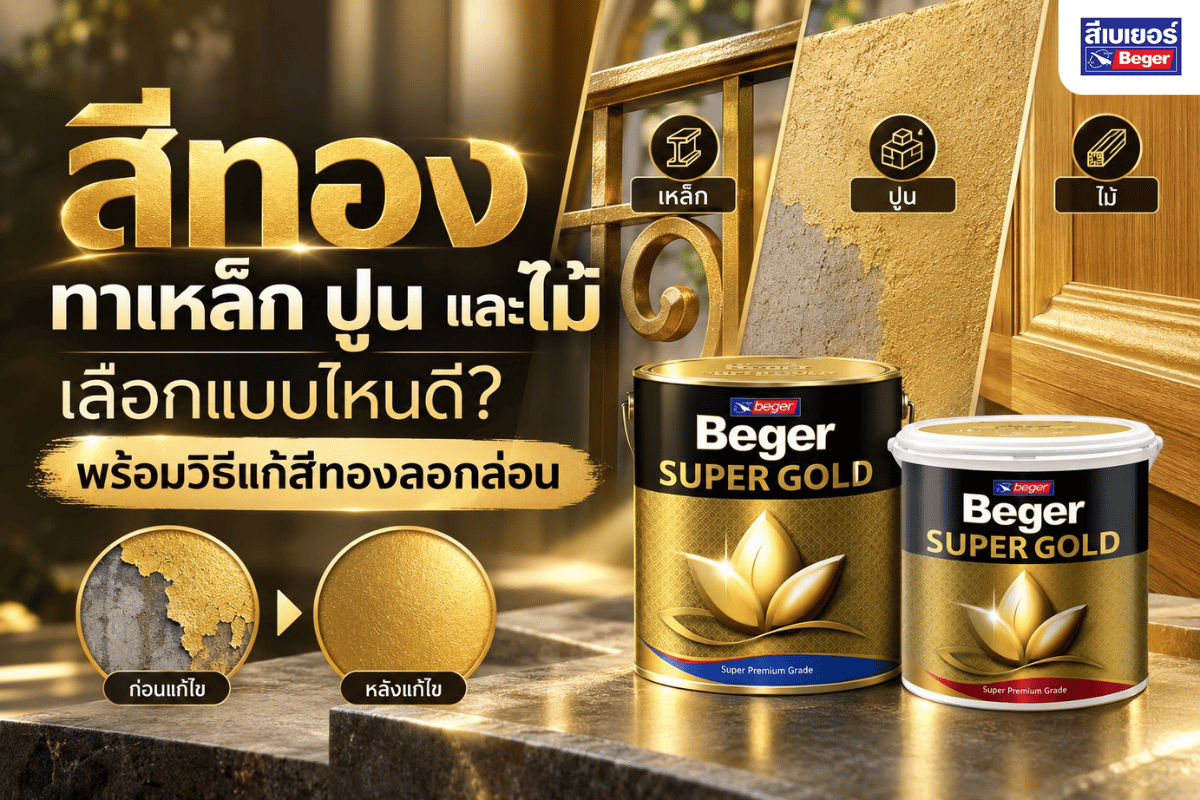
Gold is one of the shades that enhances the prominence and luxury of decorations, whether it is gold paint for metal, gold paint for concrete, gold paint for wood furniture, DIY projects, or even architecture and religious sites. However, many people encounter problems after painting with gold, including peeling gold, dull colors, fading, or blotchy gold. These issues do not arise solely from the quality of the topcoat but may start from choosing an unsuitable paint formula for the surface, inadequate surface preparation, using the wrong primer or intermediate coat, as well as using the wrong type of thinner. Therefore, if you want your gold work to look beautiful and uniform, adhere well, and maintain its shine for a long time, it is essential to choose the “gold system” that is suitable for the surface from the beginning.
Why does gold paint peel, dull, and fade quickly?
Before addressing the issue of peeling gold paint, it is important to identify the cause first, as repainting gold immediately may cause the same problems to reoccur. Generally, gold paint issues often arise from surface preparation and the paint system rather than the gold topcoat itself. For instance, surfaces may have moisture, rust, dust, or grease, as well as choosing a paint formula that does not match the material.
Therefore, do not view gold paint as merely a “topcoat” that can be applied directly onto materials, but rather as a system that consists of surface preparation, primer or intermediate coat, and gold topcoat each part affecting the beauty and lifespan of the paint film
Gold paint 3 formulas, choose according to the work on cement, wood, and metal
Gold paint comes in several formulas because each type of surface has different properties. For example, cement walls must withstand moisture and alkalinity of the material, while metal is at risk of rusting, and wood expands and contracts with moisture. Therefore, before choosing paint, it is advisable to ask “What surface will we be applying it on?”
| Header | Acrylic Water Formula | Oil Formula | Lacquer Formula |
|---|---|---|---|
| Suitable Surfaces | Cement, Concrete, Plaster | Cement, Wood, Metal |
Cement, Wood, Metal as per product system |
| Can it be used outdoors? | Yes | Yes | No |
| Solvent | Clean Water | Thinner M-1199 or M-1188 | Model-specific thinner as labeled |
| Gloss | Beautiful gloss | High gloss, strong film | Highest gloss |
| Drying Speed | Fast drying | Slower drying but smooth flow | Fastest drying |
| Highlights | Alkali resistant, moisture-releasing from cement | Scratch resistant, weather resistant | Fine glossy finish, quick work |
| Suitable for | House pillars, fences, temple walls, plaster patterns | Carved wooden doors, wrought iron, stair railings | Shrine cabinets, altars, picture frames |
| Beger model | A/C 919 (GoldSwiss), A/C 707 (Gold Europe) | A/E 234 (GoldSwiss), A/E 303 (Gold Europe) | A/L 123 (GoldSwiss), A/L 202 (Gold Europe) |
If it is gold paint for plaster, the acrylic water-based formula will be the most suitable option for the surface. If it is gold paint for metal or gold paint for wood, you can consider the oil-based formula, which supports surfaces such as plaster, wood, metal, and other metals. The lacquer formula can be used on various surfaces according to the product system and is suitable for jobs that require a glossy paint film and quick drying.
Choose from your work surface
| Your Work Site | Recommended Formulas | Topcoat Color Model | Red / Yellow Primer |
|---|---|---|---|
| Concrete Walls, House Columns, Exterior Fences | Acrylic Water-Based Formula | A/C 919 or A/C 707 | A/P 1001 (Red) /A/P 1002 (Yellow) |
| Stucco Pattern, Exterior Work | Acrylic Water-Based Formula | A/C 919 or A/C 707 | A/P 1001/A/P 1002 |
| Exterior Wooden Doors and Windows | Oil-Based Formula | A/E 234 or A/E 303 | A/E 8866 (red) /A/E 8855 (yellow) |
| wrought iron stair railings, iron fences | oil formula | A/E 234 or A/E 303 | A/E 8866/A/E 8855 |
| altar cabinets, wooden home altars | lacquer formula | A/L 123 or A/L 202 | as specified on that model’s label |
| picture frames, interior decorative furniture | lacquer formula | A/L 123 or A/L 202 | As specified on the label of that model |
Beger Super Gold Products
Select product details by formula type
Water-based Formula
Oil-based Formula
Lacquer Formula
Water-based Primer
Oil-based Primer
Swiss Gold vs. European Gold: Which Shade to Choose
All 3 formulas are available in 2 main shades, which differ in color temperature tone but not in quality or durability.
| Topics | Swiss Gold | European Gold |
|---|---|---|
| Color Tone | Light yellow, bright, clean | Dark reddish, luxurious, solemn |
| Feel | Light, modern | Heavy, powerful |
| Suitable for | Classic European work, modern decoration | Temple work, Thai applied art, auspicious furniture |
| Beger Models | A/C 919, A/E 234, A/L 123 | A/C 707, A/E 303, A/L 202 |