
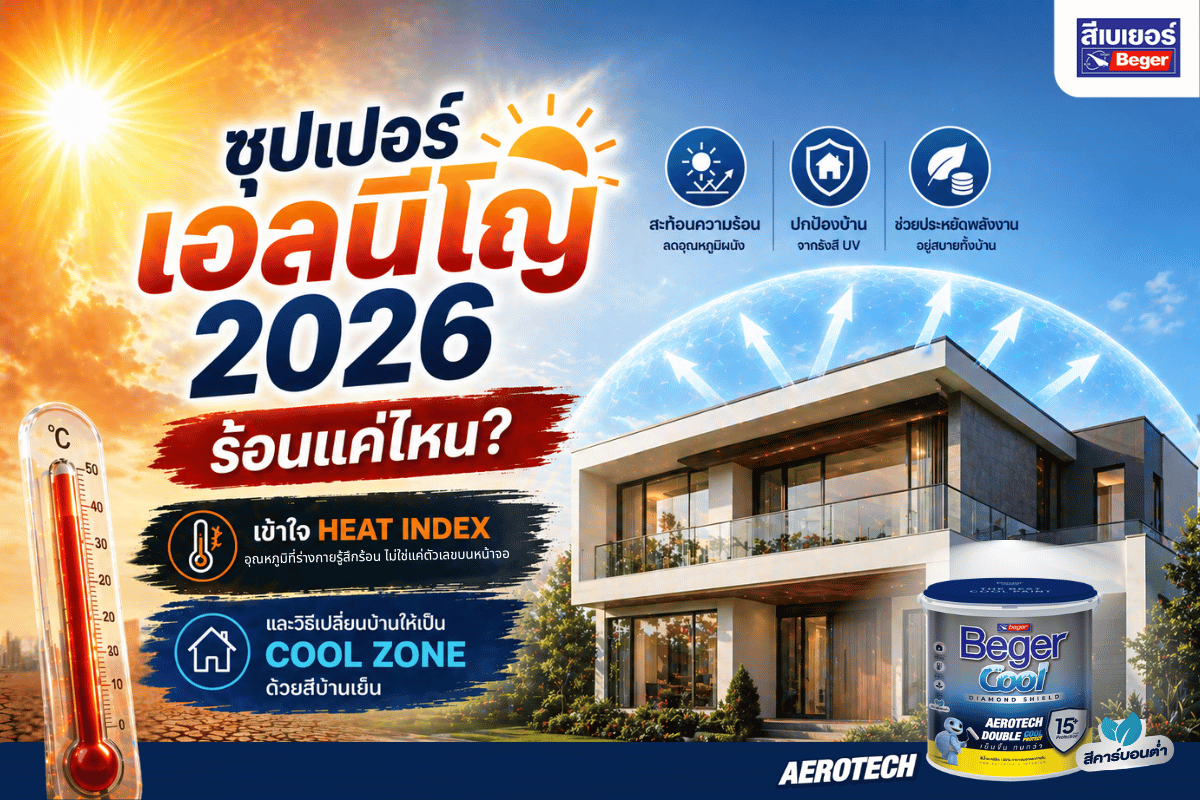
When Super El Niño causes the Earth’s baseline temperature to rise, combined with the Urban Heat Island (UHI) phenomenon that causes cities to accumulate more heat than surrounding areas, the heat intensifies even more, especially in Bangkok, where the temperature difference between the city center and surrounding areas can reach as high as 6–7°C during certain times of the year. This heat does not stop outside buildings but is absorbed through walls and roofs, gradually releasing heat into the home throughout the evening and night, causing homes to retain heat, making sleep uncomfortable, and using more energy for cooling than necessary. This is why reducing heat from the “source” of the house has become an important approach to coping with the increasingly severe weather conditions today.
What is El Niño? Why does it make the weather hotter?
El Niño is a natural phenomenon caused by changes in sea surface temperatures in the eastern and central Pacific Ocean, which are “higher than normal.” Normally, trade winds push warm water towards Southeast Asia, but during El Niño, these winds weaken, causing warm water to accumulate in the ocean and resulting in changes to global weather patterns.
What follows is:
- overall air temperatures rising
- heat accumulating longer than usual
- irregular rainfall
For Thailand, El Niño results in:
- prolonged extreme heat for several months
- difficulty cooling down at night
- building surfaces accumulating more heat
When reaching the level of “Super El Niño,” the heat intensifies further, directly impacting health, daily life, and the structure of homes.

What is the Heat Index? Why does it feel hotter than what is measured?
Heat Index or “heat index” is a value used to measure the “actual heat sensation of the body” by not only considering temperature but also including “humidity in the air.”
For example:
- Temperature 36°C
- High humidity
- The body feels like 40–45°C
The main cause is: the human body uses “sweat” to cool down, but when the air is humid, sweat evaporates slowly, resulting in heat accumulation in the body.
Consequences:
- Easily fatigued
- Dizziness
- Risk of heatstroke
- Feeling uncomfortable even indoors
This means that a “hot and humid home” will unknowingly increase the Heat Index.
When the weather is hot, the home is a direct heat reservoir.
In the hot weather of Thailand, a home is not just a place to live but becomes a “heat absorber and storage.”
Especially:
- Concrete walls
- Roofs
- Rooftops
During the day, these surfaces continuously absorb heat from sunlight and retain it within the structure.
What happens is:
- Walls become hot to the touch
- Heat radiates into the house
- At night, the house remains hot (Heat Lag)
The resulting effects:
- Running the air conditioner longer
- Higher electricity bills
- The comfort of living has decreased
Thus, a house is not just “exposed to heat” but is now “retaining heat” all day long
What is the “Cool Zone” concept?
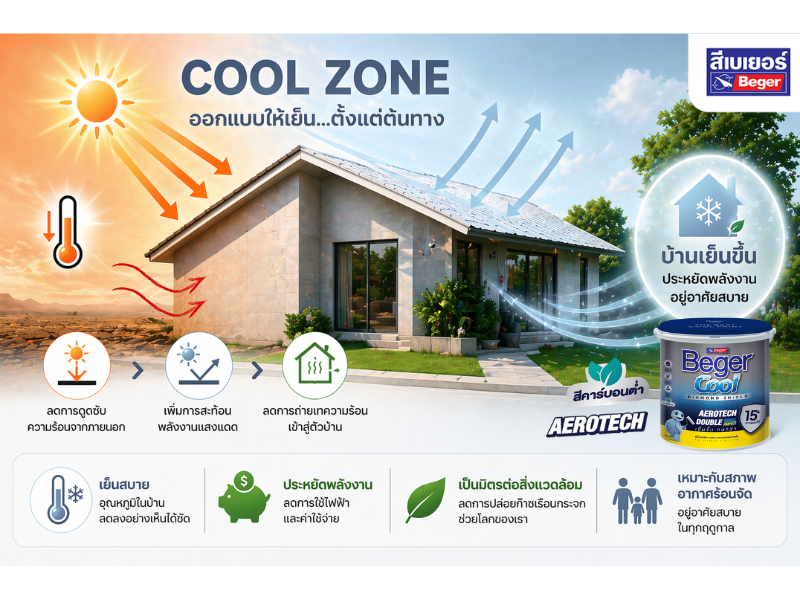
Cool Zone is a design concept for homes that can “reduce heat absorption and decrease heat accumulation” in a systematic way. The goal is not just to make the house cool, but to “control the house temperature from the source.”
This concept consists of:
- Reducing heat absorption from the outside
- Increasing the reflection of sunlight energy
- Reducing heat transfer into the house
When accomplished, the house will be cooler without overly relying on air conditioning.
Cool Zone is therefore a concept that meets both:
- Living comfort
- Energy savings
- Living in extremely hot weather
Do cool house colors really help?
Cool house colors, or heat-reflective colors, are not just “decorative colors” but materials that play a role in controlling the temperature of the house. The main working principles consist of 3 systems called REI
1. Heat Reflection (Solar Reflectance) reduces energy absorption from sunlight from the source
2. Heat Emission (Thermal Emission) helps dissipate heat from the surface
3. Reducing Heat Conduction (Insulation Effect) reduces heat transfer into the interior of the house
The results that occur:
- Less heat on the walls
- Cooler homes
- Reduced burden on air conditioning
Transform your home into a Cool Zone with cool house paint
One of the practical and quick methods is to choose house paint that has heat-reflective properties
Examples of approaches:
- Paint exterior walls with heat-reflective paint
- Reduce the main heat accumulation points of the house
- Enhance the Cool Zone system without major structural adjustments
For example, paints that use technology:
- Nano Ceramic
- Heat Reflective
Can help:
- Reflect high heat energy
- Actually reduce wall temperatures
- Increase comfort inside the home
Why in 2026 “we must think about cool house paint”
Super El Niño 2026 is not just an unusually hot year, but a signal of a “long-term trend”
What is happening is:
- Average temperatures are rising
- Heat Index is increasing
- Heat accumulation in cities is increasing
Traditional homes that are not designed to cope with heat will start to become “increasingly difficult to live in.” Adaptation is therefore not an option but a “necessity,” and one of the most effective ways is to use cool house paint to reduce heat from the source.
Super El Niño 2026 is a clear reflection that “heat” is becoming an increasingly important factor affecting daily life each year. It is not just the rising temperatures, but also the Heat Index that makes the body feel hotter and more uncomfortable than the numbers indicate, along with the structure of the house that unknowingly accumulates heat. Therefore, adaptation should start from “the house,” which is the area where we live the most. The Cool Zone concept and the choice of cool house paint or heat-reflective paint is one of the approaches that effectively helps reduce heat accumulation. When a house can reduce heat absorption and retention, living conditions become more comfortable, energy use decreases, and it can better cope with increasingly severe weather in the long term.
Product Recommendations
FAQ Frequently Asked Questions about El Niño and Understanding the Heat Index
Q1: What is Super El Niño 2026 and how does it affect Thailand?
A1: Super El Niño is a phenomenon that causes abnormally high temperatures at a severe level, resulting in Thailand facing prolonged extreme heat, high humidity, and irregular rainfall, leading to increased heat accumulation in homes and making living conditions more difficult.
Q2: What is the Heat Index and how dangerous is it?
A2: The Heat Index is a value that reflects the actual feeling of heat on the body by combining temperature and humidity. When the Heat Index is high, it can cause symptoms like fatigue, dizziness, and increase the risk of heat stroke.
Q3: Why does the house get hotter during El Niño?
A: During El Niño, continuous high temperatures cause walls and roofs to absorb heat throughout the day and release it slowly at night, resulting in homes accumulating heat and becoming more stuffy.
Q4: Do cool colors or heat-reflective paint really help reduce heat?
A4: Cool colors for homes can indeed help reflect energy from sunlight, reduce heat absorption, and lower wall temperatures, resulting in cooler interiors and reduced air conditioning workload.
Q5: What is the Cool Zone concept and how does it help keep homes cooler?
A5: The Cool Zone is a design concept aimed at reducing heat absorption and accumulation by using materials and technologies, such as heat-reflective paint, to control home temperatures from the outset, making homes cooler and more comfortable.
Q6: How should we prepare our homes for heat in 2026?
A6: Start by reducing heat accumulation sources, such as walls and roofs, by choosing cool colors, improving ventilation, and reducing energy use within the home to enhance comfort and lower electricity bills in the long run.