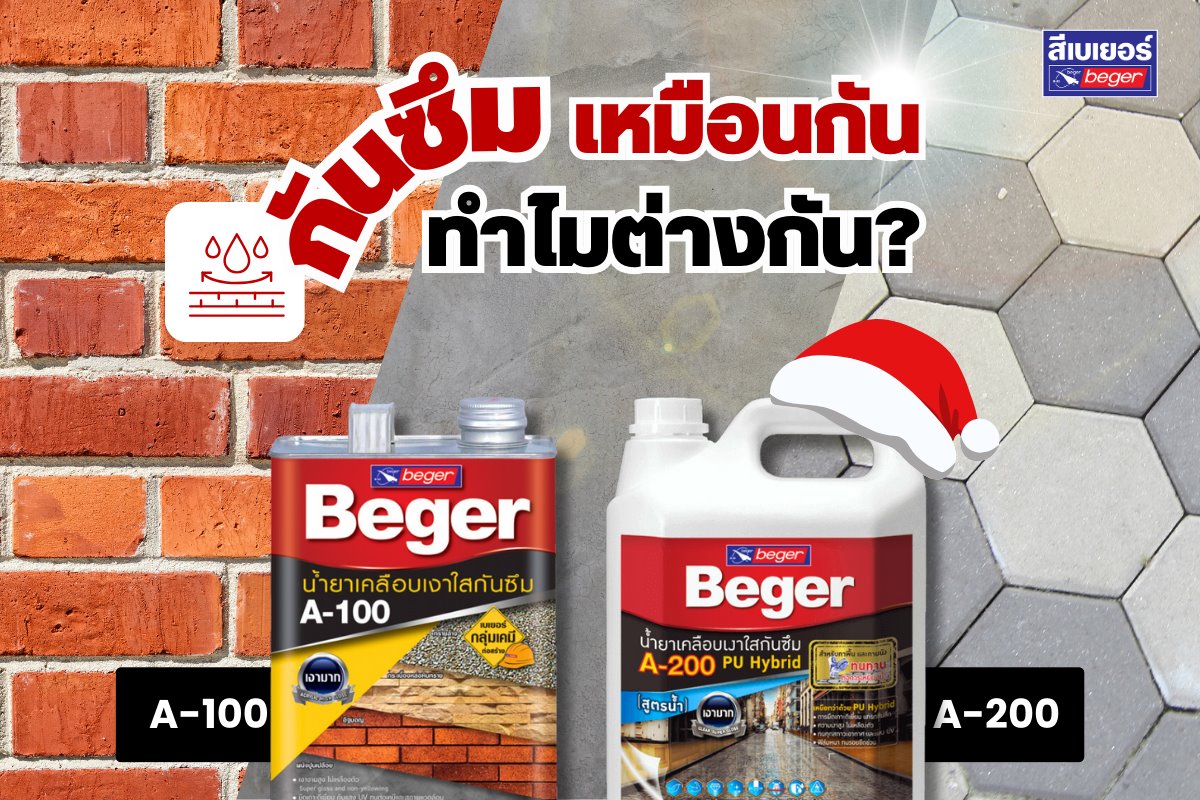
The A100 and A200 sealants differ mainly in “formula” and “application area.” A100 is a clear gloss coating with an oil-based formula, featuring a high Hi-Gloss film, suitable for wall applications only. On the other hand, A200 is a water-based formula with PU Hybrid technology, has a mild scent, and a harder film, making it suitable for both floor and wall applications and resistant to foot traffic. The simple rule is: if it’s purely a wall and you want the shiniest gloss, choose A100. However, if the area will have foot traffic or is an indoor space where you want to avoid strong odors, choose A200.
Comparison Table: A100 and A200 Sealants
See the differences of the sealants compared point by point in this table
| Category | A100 | A200 PU Hybrid |
|---|---|---|
| Formula | Oil-based formula | Water-based formula with a mild scent |
| Main Ingredients | High-quality acrylic polymer | Acrylic mixed with polyurethane (PU Hybrid) of special grade from Germany |
| Appearance in the Can | Clear like water | Opaque white like milk (Dry clear) |
| Application Area | Wall applications only | Floor and wall work, both interior and exterior |
| Foot traffic resistant | Not resistant | Resistant, hard film, and scratch-resistant |
| Film type | High gloss level Hi-Gloss | Available in both gloss and matte types |
| Solvent / Dilution mixture | Thinner M-1199 | Clean water |
| Odor | Has a solvent smell, must ensure good ventilation | Very faint odor, suitable for interior work |
| Usage rate | Approximately 40–50 sq.m./coat (Size 3.5 liters) |
10–12 sq.m./liter/coat or about 35–42 sq.m./coat (Size 3.5 liters) |
| Drying time between coats | 4–6 hours | 2–4 hours |
| Shelf life | More than 3 years | More than 3 years |
| Who is it suitable for | Bare concrete walls, exposed bricks, exposed stones that want the highest gloss finish | Walkways, garages, balconies, stamped concrete, and indoor work that requires a light scent |
Choose A100 or A200? Answer based on the usage area
Select from these 3 questions in order, and you will get an answer within seconds
- Does that area have people walking? Walking on A200 / Not walking (all walls) go to question 2
- Is it indoor work or an area with little airflow? Indoor/little airflow A200 (light scent) / Open outside go to question 3
- Do you want the highest glossy finish or a moderate/dull finish? Highest glossy A100 / Want to choose both glossy and dull A200
Common examples found in real homes
- Bare concrete walls in a loft style living room A200 type matte (light scent, does not disturb people in the house)
- Exposed brick wall in front of the house, exposed to sun and rain A100 (high gloss, emphasizes material surface)
- Washed stone, washed sand, walkways around the house A200 (resistant to foot traffic, non-slip after application)
- Stamped concrete / worm block in front of the garage A200
- Statues, pots, ceramic items A200
What is A100 waterproofing agent?
A100 A100 is a clear gloss sealer with a water-based formula made from high-quality acrylic polymer, designed for coating natural materials such as plaster, stone, and brick. It provides a thick, high-gloss film that does not yellow over time. The main selling point is that it showcases the original surface of the material without changing its color, while increasing gloss and sealing pores at the same time.
The highlight of A100 lies in its deep penetration, allowing for excellent adhesion and providing a thick surface film that effectively prevents water seepage, resists alkalinity from plaster surfaces, withstands chemicals, and endures sun and rain. The result is protection against embedded dust, mold, and algae, while also being easy to wipe clean.
What can A100 be applied to?
The answer is Wall applications primarily include:
- Bare plaster walls, polished plaster walls
- Block walls, red brick, exposed brick
- Sandstone tiles, slate, washed stone, washed sand, natural stone
- Terracotta tiles
Limitations to be aware of: A100 is not suitable for flooring and walkways because the film does not withstand foot traffic. If applied to garage floors or walkways, the film will scuff and peel off faster than expected.
What is A200 waterproofing agent?
A200 is a clear gloss waterproofing agent with a water-based formula that has a non-offensive odor. It is produced using PU Hybrid technology (a blend of acrylic and polyurethane) of special grade from Germany, designed for application on both floors and walls, and is resistant to foot traffic. It is considered an upgraded version of the traditional clear coating in terms of film hardness and safety regarding odor.
Key features of A200 according to Beger product information:
- Penetrates deeply into the material, providing excellent adhesion and maximizing waterproofing efficiency.
- High gloss, does not yellow, available in both glossy and matte finishes.
- Resistant to all weather conditions and UV rays, with a thick film that withstands scratches.
- After application, the floor is not slippery, which is a significant advantage for flooring that people often worry about.
- Water-based formula, non-offensive odor, does not contain mercury or lead.
What can A200 be applied to?
Can be applied to both floor and wall work covering a variety of materials more than A100
- synthetic wood, fiber cement
- concrete walls and floors, bare concrete walls, all types of loft walls
- stamped concrete, worm block, exposed brick
- natural stone, sandstone, slate, washed stone, washed sand
- ceramic tiles, pottery, sculptures
except: should not be used on ceramic tile and granite surfaces as the surface is too dense for the solution to penetrate and adhere well
How to use A100 and A200 waterproofing agents
It is important to always prepare the surface beforehand by cleaning it from various dirt stains and leaving it to dry completely. If there is old paint, it should be completely removed first.
A100 and A200 can be applied directly, but to make it easier to apply the solution, the solution should not be too thick. It is recommended to use it with thinner or clean water in the following proportions:
- A100 oil-based formula should be mixed withThinner M-1199If using a brush or roller, mix no more than 10%. If using a sprayer, it is recommended to mix no more than 15%.
- A200 water-based formula should be mixed with clean water. If using a brush or roller, mix no more than 5-10%. If using a sprayer, it is recommended to mix no more than 20%.
It is recommended to apply A100 or A200 waterproofing agent in 2 complete coats, allowing each coat to dry before applying the next. A100 should be left to dry for at least 4-6 hours, while A200 should be left to dry for at least 2-4 hours.
Example of using clear gloss coating
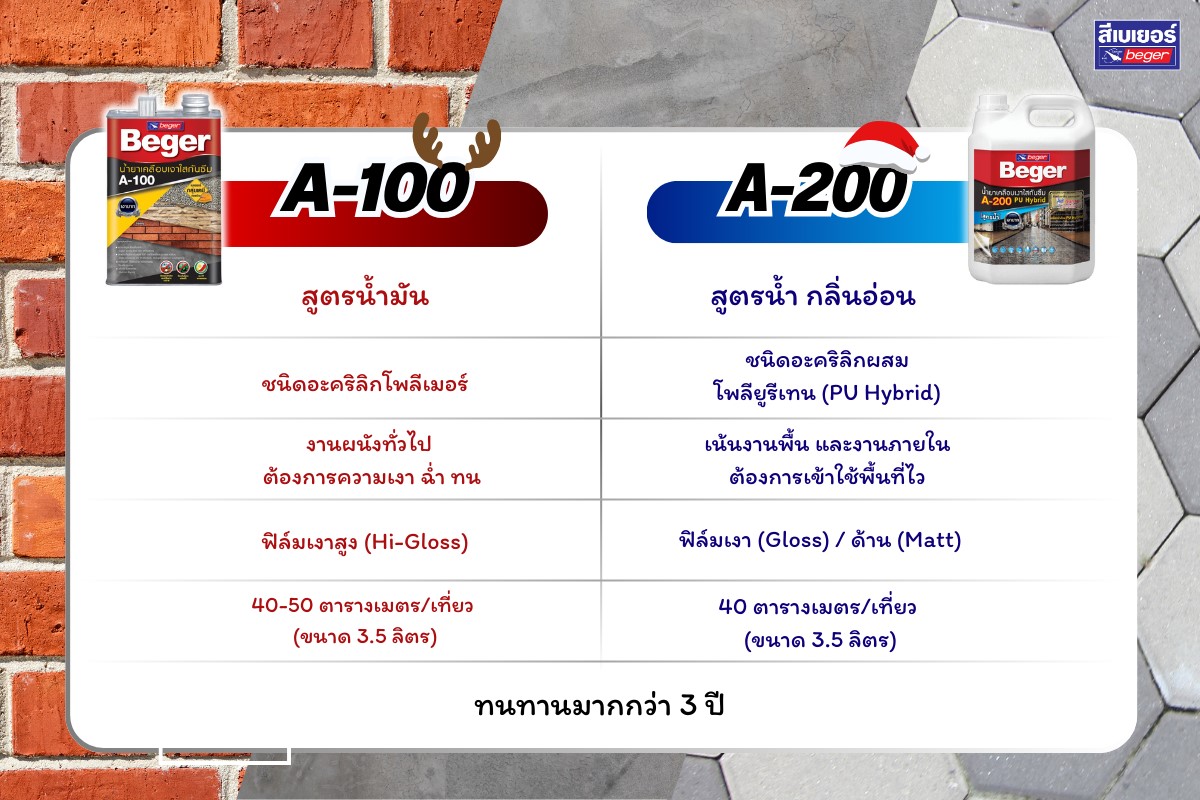
Comparison: How do A100 and A200 waterproofing agents differ?
Now let’s look at the differences between A100 and A200 waterproofing agents in terms of formula, application area, film type, and durability that many people are curious about!
Formula:
- A100 oil-based formula, high gloss
- A200 water-based formula, non-pungent smell
Main ingredients:
- A100 is made from clear acrylic polymer.
- A200 is made from PU Hybrid, opaque like milk.
Usage:
- A100 is for general wall applications, enhancing glossiness, moisture, and durability.
- A100 is for flooring and interior work, focusing on quick usability and resistance to foot traffic.
Film characteristics:
- A100 has a high gloss film level (Hi-gloss).
- A200 has a glossy film and a matte film.
Application area:
- A100 covers approximately 40-50 square meters per coat (size 3.5 L).
- A200 covers approximately 40 square meters per coat (size 3.5 L).
Durability:
- A100 and A200 are durable for over 3 years.
5 precautions before applying clear gloss coating:
The most common complaint from homeowners after applying clear coating is “the wall color is darker than before.” This is not a defect of the coating but a characteristic of the clear film that gives the surface a Wet Look, similar to when the wall is wet.
- Always test in a small area first. Apply a test in a less prominent corner, wait for it to dry completely, and check the actual color tone before applying to the entire wall.
- Glossy types will make the color appear darker than matte types. If you want to maintain the original cement tone as closely as possible, you should choose A200 in matte.
- Clear coating is not a paint to cover blemishes. Existing stains, marks, or uneven plaster will still be visible and may become more pronounced after coating.
- Do not apply on damp surfaces. Moisture trapped under the film can cause the film to become cloudy or peel off later.
- Do not use on ceramic tiles and granite tiles because the surface is too tight for the solution to penetrate and adhere.
If you are dealing with moisture issues throughout the house, read more in the article Leaky House, Cracked House, Mold-Termite Invasion! Comprehensive Solutions for the Rainy Season
Why do concrete, stone, and brick walls develop mold and algae?
Because the surface of natural materials is highly porous, it absorbs water and retains moisture, which are conditions that mold and algae need to thrive. When combined with the hot and humid weather and rain in Thailand, uncoated bare concrete or washed stone walls can develop black-green stains in a short time. Coating with a waterproofing solution addresses the root cause, which is closing the pores to prevent water and moisture from accumulating. This is different from simply cleaning stains, which is a temporary fix, and the stains will return in the next rainy season.
FAQ Frequently Asked Questions about
Q1: What is the difference between A100 and A200 in the shortest terms?
A1: A100 is an oil-based formula with a high gloss, suitable only for wall applications, while A200 is a PU Hybrid water-based formula with a mild scent, suitable for both floors and walls, and is resistant to foot traffic.
Q2: Can A100 be used on floors?
A2: Not recommended, as the film of A100 is not resistant to foot traffic. If you need to coat walkways, garage floors, or balconies, you should use A200 PU Hybrid, which is specifically designed for flooring.
Q3: Will using A100 or A200 make the floor slippery?
A3: A200 clearly states “non-slip” properties, making it a more suitable choice for flooring. However, all types of floors can become slippery when wet. High-risk areas, such as ramps or pool edges, should consider using a textured type as well.
Q4: If the wall darkens after applying a clear coating, can it be fixed?
A4: Darkening of the surface is a normal characteristic of a Wet Look clear film and is not damage. If you do not want this tone, you must strip the film using a paint stripper and start over. The best method is to test on a small area before applying it to the entire project.
Q5: If the wall already has mold, can I just coat over it?
A5: No, you must completely remove the mold and algae first using a mold remover, such as Beger Mold Free M-001, and allow it to dry thoroughly; otherwise, the mold will be trapped under the film and continue to spread.
Conclusion
When choosing a waterproofing solution, A100 or A200, prioritize “application area” first. For walls that require maximum gloss, choose A100 oil-based formula, while for flooring, interior work, or areas with foot traffic, choose A200 PU Hybrid water-based formula, which is more durable, has a lighter scent, and is available in both gloss and matte finishes. Then, emphasize surface preparation and apply in two coats, as these are the two factors that determine whether the work will last more than 3 years. If you are still unsure which product to use, read the article Choosing the Right Clear Moisture-Proof Coating from the Start—More Important Than You Think.