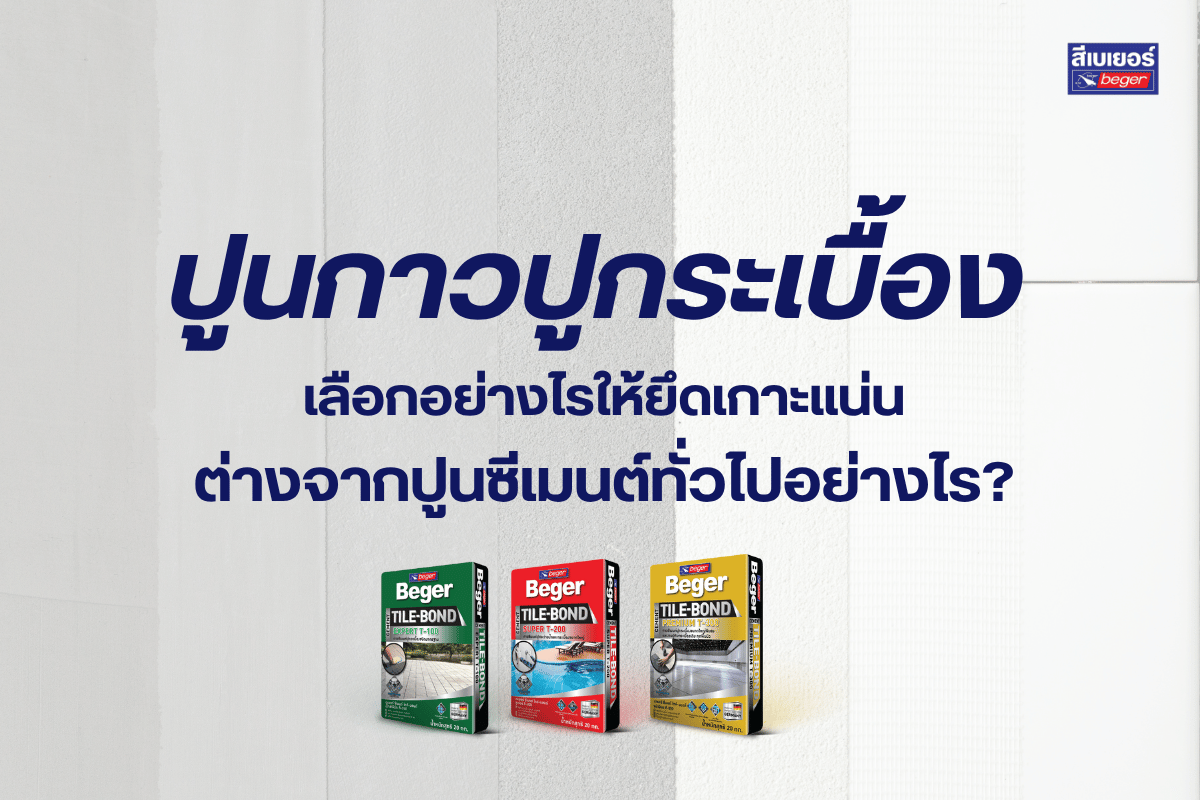
A stable home starts with a strong structure, beginning with the selection of appropriate materials.
Currently, it is found that over 70% of homes in Thailand prefer to use “concrete” as the main structural material due to its strength, durability, and long lifespan. Concrete is a material composed of cement, stone, gravel, and water, which, when mixed in the right proportions, undergoes a chemical reaction and hardens, becoming a stable and strong structure. However, even with a good structure, if the concrete walls have issues such as uneven surfaces, cracks, or peeling, it will impact both the aesthetics and the comfort of the residents, especially during the tiling process, which requires adhesive materials with effective bonding properties. This article will provide essential knowledge about the types of cement, how to choose cement adhesive suitable for tiling work, as well as recommendations for products that can effectively solve problems, ensuring that your tiling work is smooth, strong, and long-lasting.
Frequently Asked Questions about Cement and Tiling
1. How many types of cement are there, and how do they differ?
Cement is divided into several types, which can be summarized as follows:
- Ordinary Portland Cement: suitable for structural work such as columns, beams, floors, and foundations.
- Ready-Mixed Cement: convenient to use, packaged and ready for use, suitable for plastering, leveling, or floor adjustments.
- Cement Adhesive: developed specifically for tiling, with high bonding properties and good moisture resistance.
2. How does cement adhesive differ from ordinary cement?
Cement adhesive is specifically designed for tiling work, with the following distinctive properties:
- high bonding strength, suitable for use on floors and walls.
- Thick consistency, does not sag, easy to use even in vertical applications.
- Reduces the risk of tiles peeling off.
While ordinary cement is strong, it is not designed to adhere to tile surfaces or non-absorbent materials, so it should not be used as a substitute for cement adhesive.
3. How many types of cement adhesive are there, and what are they suitable for?
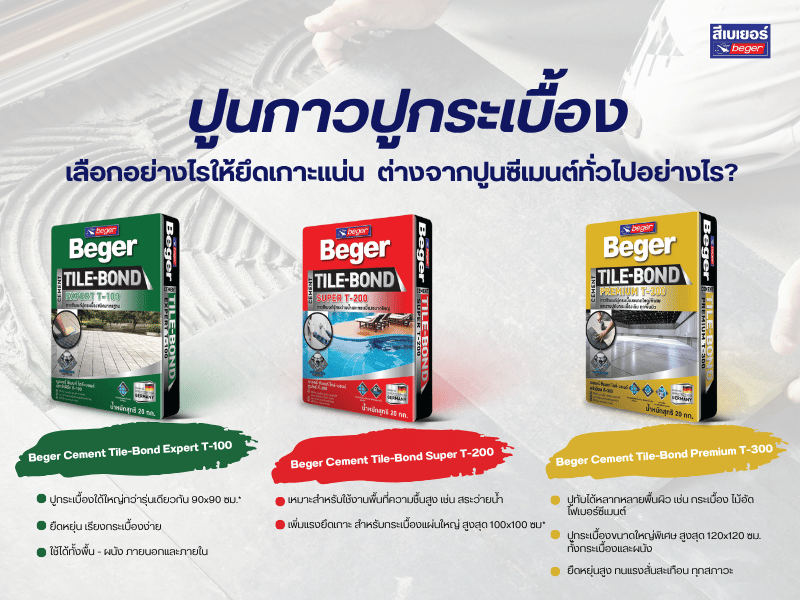
Beger products recommend three types of cement adhesive, including:
- Beger Tile-Bond Expert T-100 (Green):
suitable for standard-sized tiles, usable on both floors and walls, accommodating tiles up to 90×90 cm.
- Beger Tile-Bond Super T-200 (Red):
Suitable for large tiles or use in humid areas such as swimming pools, supports tiles sized 100×100 cm.
- Beger Tile-Bond Premium T-300 (gold color):
Supports oversized tiles, compatible with existing tiles, rubber wood, granite, or fiber cement, supports a maximum size of 120×120 cm.
4. Can ordinary cement be used instead of tile adhesive cement?
Not recommended because regular cement does not have high adhesion properties, especially on non-absorbent surfaces such as tiles or natural stone, which may lead to detachment problems in the long term.
5. Can tile adhesive be applied over old tiles?
Yes, it can be done if you choose products designed to accommodate such applications, such as Beger Tile-Bond Premium T-300, which can adhere to various surfaces including old tiles, composite wood, and fiber cement materials.
Summary
Choosing the right tile adhesive cement for the type of tiling work is a crucial factor that directly affects the overall quality of the work in terms of strength, smoothness, and durability. Investing in quality products like Beger Tile-Bond Series is a smart choice for homeowners, skilled craftsmen, and professional contractors. If you want your floors and walls to look perfect, adhere firmly, and last long, quality tile adhesive is the right answer.
Find a store near you >> Click here to find a store near me
Contact the Beger expert team for free advice! >> Click to contact the staff