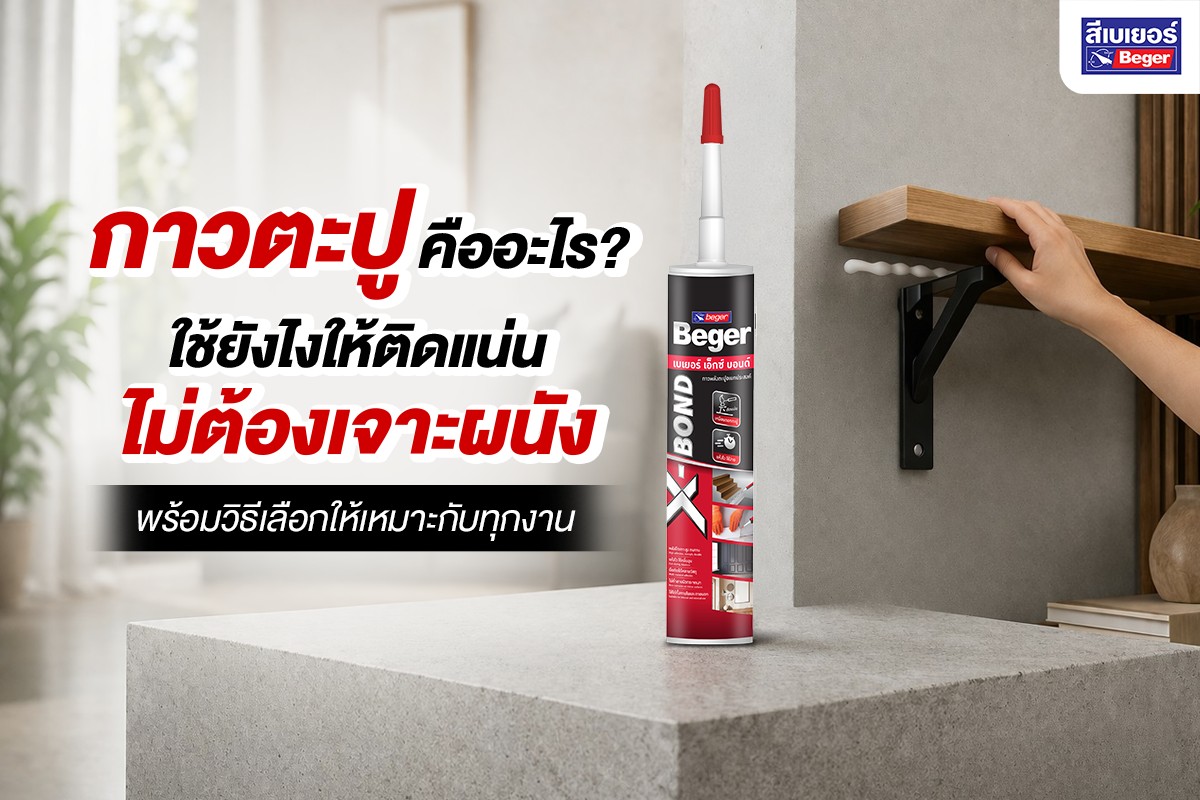
Nail Glue (or Power Nail Glue) is a high-strength multipurpose adhesive used as an alternative to nails or screws. It can bond materials such as wood, concrete, tiles, metal, and glass to walls without making holes. The water-based nail glue can support a weight of about 100 kilograms per square meter, while the solvent-based formula can support even more weight, making it the top choice for people living in condos where wall drilling is not allowed, and homeowners who want to hang picture frames, shelves, or mirrors without leaving marks on the walls.
What is Nail Glue?
Nail glue is a high-strength multipurpose adhesive developed to replace nails or screws in general installation tasks. Its working principle is to create a bonding connection between both surfaces, which distributes force evenly across the area where the glue is applied, unlike nails that bear force at a single point. This results in a more secure hold and reduces the chances of materials falling off.
Nail glue typically comes in a tube that is used with a glue gun, allowing for precise control of the amount used. Even those without handyman skills can use it for DIY projects. In other countries, this type of glue is referred to as construction adhesive.
Water-based Nail Glue vs. Solvent-based Nail Glue: What’s the Difference?
Water-based nail glue is suitable for indoor use because it has a mild odor, while solvent-based glue dries faster and is more resistant to moisture and weather conditions, making it ideal for outdoor use and heavy-duty applications.
| Features | Water-based Nail Glue | Solvent-based Nail Glue |
|---|---|---|
| Odor | Mild, safe for indoor use Air-conditioned rooms |
Strong odor, requires ventilation |
| Weight capacity | About 100 kg/sq.m. | Higher than water-based (check the label of each variant) |
| Drying time | Medium | Faster |
| Moisture/weather resistance | Medium | Better suited for outdoor work |
| Flexibility | Good, supports material expansion | Strong but tougher |
| Suitable for | Interior decoration of homes and condos | Outdoor work, heavy-duty, uneven surfaces |
What materials can nail glue be used with?
High-quality nail glue adheres to almost all types of construction and decorative materials found in homes, especially porous surface materials where the glue penetrates and adheres best
Supported materials
- Plaster walls / Concrete / Fiber cement Attach ceiling moldings, decorative trim, wall decoration panels
- Real wood, plywood, synthetic wood Shelving, baseboards, wooden wall panels
- Metal Attach steel frames, decorative metal sheets
- Glass and mirrors Attach bathroom mirrors, mosaic glass (choose a formula that specifies it won’t damage the mercury coating on the back of the glass)
- Ceramic tiles Repair loose tiles in specific areas (if tiling a full area, it is recommended to use cement glue specifically for tiling) and see how to repair tile grout by yourself assembly)
- PVC / UPVC / Vinyl Work for doors and windows, plastic trims
Materials to avoid
- Teflon (PTFE), PE / PP plastic Low energy surface, glue does not adhere
- Copper Reacts to reduce adhesion strength
- Surfaces with oil stains, dust, or high moisture Must be cleaned and allowed to dry beforehand
How to use nail glue for strong adhesion in 4 steps
The key to using nail glue for strong adhesion is “clean and dry surface, press firmly long enough, wait for full setting.” Follow these 4 steps
1. Prepare the surface Wipe both sides of the surface dry, free from dust, oil stains, and moisture. This is the most important step because a dirty or damp surface is the number one cause of nail glue not adhering or coming loose later.
2. Cut the tip of the tube and apply the glue Cut the tip of the tube at an angle, about 6 mm hole size. Insert the tube into the glue gun, then apply the glue in a straight line, zigzag, or as dots with spacing. Do not cover the entire area to allow the glue to spread when pressed together.
3. Press and hold for 3–5 minutes Press the material down onto the surface with consistent force for about 3–5 minutes to allow the glue to start adhering.
- Light items (picture frames, trims, moldings): Press together, hold firmly, and use tape to temporarily secure until the glue sets.
- Heavy items (shelves, large glass panels): Must use support equipment or clamps for about 24 hours. Do not let the glue bear weight on its own during the setting period.
4. Wait for the glue to fully dry for 24–48 hours before actual use The glue begins to set within a few hours, but full adhesion strength requires waiting 24–48 hours as indicated on the product label. Rushing to hang items immediately after installation significantly reduces adhesion strength.
How many kilograms can nail glue hold?
High-quality water-based nail glue generally holds about 100 kilograms per square meter, while oil-based formulas can hold more. Some professional-grade products on the market indicate initial weight capacity up to 200–300 kg/m².
Factors determining actual weight capacity on-site:
- Adhesive Formulation and Quality Adhesion strength on the label (kg/m²) The higher it is, the more weight it can support
- Area where the adhesive is applied Weight capacity Adhesion strength × Actual contact area For example, if the adhesive supports 100 kg/m² and the actual contact area is 0.1 m², it can support approximately 10 kg.
- Type of material Porous materials like cement and wood adhere better than smooth surfaces
- Cleanliness and dryness of the surface
Safety recommendations: For heavy load-bearing tasks or overhead installations, such as large shelves or large glass panels, always reinforce with screws or anchors.
How many meters can be applied with one tube of adhesive?
A standard tube of adhesive is approximately 280–300 milliliters and can apply a bead of adhesive with a diameter of 6 mm for about 10 meters. If a larger bead is applied, the distance will proportionally decrease.
Rough calculation method before purchase: Measure the total length of the line where adhesive needs to be applied (meters) ÷ 10 = Approximate number of tubes, plus an additional 10–15% for spots that need to be reapplied.
How to remove adhesive without damaging the wall
Dried adhesive can be removed by using heat to soften it, then gently cutting it away with a thin tool. Avoid prying as it may pull off the wall surface or paint.
- Use a hairdryer or hot air gun to blow on the adhesive for about 1–2 minutes to soften it.
- Use fishing line or thin wire to slide behind the material and slowly saw it away from the wall.
- For leftover adhesive on the wall, use a plastic scraper to gently scrape or sand with sandpaper.
- If the paint surface is peeling or the wall is damaged, see the repair methods in the article. What types of wall cracks are dangerous and how to repair them
Adhesive vs. Silicone vs. PU Adhesive: Which one should you choose?
Adhesive is designed to “bond and support weight,” silicone is designed to “seal joints against water,” while PU adhesive is in between, being both strong and flexible against water. They cannot be used interchangeably for all tasks.
| Criteria | Adhesive | Silicone | PU Adhesive (PU) |
|---|---|---|---|
| Main Function | Bonding materials, load-bearing | Sealing joints, waterproof | Bonding + Caulking Flexible |
| Adhesion Strength | Very High | Low (not designed for load-bearing) | High |
| Paintable | Yes (mostly) | No (general formula) | Yes |
| Suitable Work | Mounting shelves, moldings, trims Glass, decorative panels |
Caulking around sanitary ware Glass, aluminum |
Structural joints Outdoor work |
How to choose the right nail glue for your job
Choose based on these 6 factors in order of importance
- Adhesion strength on the label (kg/m²) The higher, the more weight it can hold. Compare directly with the weight of the item to be attached.
- Water-based formula for indoor use / Oil-based formula for outdoor use For indoor work, in air-conditioned rooms, choose a water-based formula with no strong odor.
- Drying time For quick jobs or multiple pieces per day, choose a quick-drying formula.
- Compatibility with materials Especially for mirrors, choose a formula that specifies it does not damage the mercury surface.
- Can be used on multiple materials in one tube Cost-effective and convenient for general DIY projects.
- Clear certification standards and TDS information Choose brands that disclose actual adhesion test results.
Beger X-Bond multipurpose nail glue from Beger
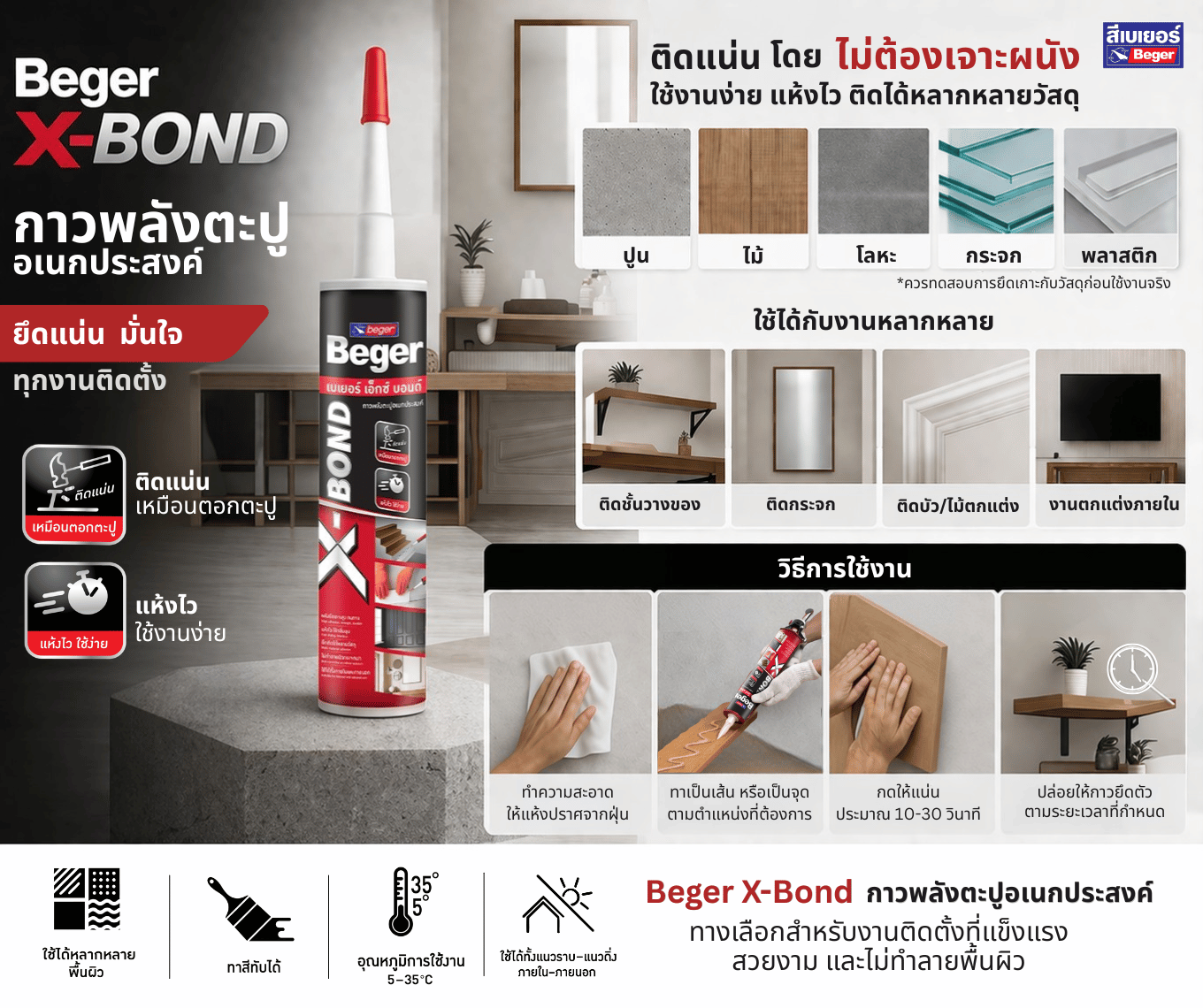
Beger X-Bond is a multipurpose nail glue designed specifically for installation and interior decoration work. Its highlights include
- High adhesion strength with an adhesion value of 150 kg/m²
- Quick drying in 15-25 minutes
- Odorless, safe for use in homes and condos
- Adheres to various materials including concrete, wood, metal, glass, and PVC
- Does not damage the surface of mirrors, suitable for bathrooms and dressing rooms
Recommended products
FAQ Frequently asked questions about nail glue
Q1: Can nail glue really replace nails?
A1 : It is indeed suitable for general installations that do not bear very high loads, such as picture frames, wall moldings, ceiling cornices, decorative panels. Quality nail glue, when used correctly, provides adhesion strength comparable to or better than nails because it distributes the force across the entire surface instead of concentrating it at a single point.
Q2 : How many hours does the nail glue take to dry?
A2 : The nail glue begins to set within the first few hours, but to dry completely and bear full weight, it needs to wait for 24–48 hours. During this time, heavy items should be supported continuously.
Q3 : How many meters can one tube of nail glue cover?
A3 : A standard tube of about 280–300 ml can cover approximately 10 meters with a 6 mm bead of glue.
Q4: Can nail glue be used on glass?
A4: Yes, but you must choose a formula that specifies it can be used on mirrors and does not damage the mercury coating on the back, as some formulas can cause the mirror to become cloudy or stained.
Q5: Can nail glue be used in bathrooms or damp areas?
A5: Yes, by selecting a formula that is moisture-resistant (oil-based formulas are better than water-based ones) and must be applied on completely dry surfaces. If the surface is damp during application, the glue will not adhere.
Q6: Can nail glue be removed? Will it damage the wall?
A6: It can be removed by using hot air to soften the glue and then using fishing line or a saw wire to separate the materials. Avoid pulling directly as this may pull off the plaster or paint.
Conclusion
Nail glue is a strong, convenient alternative for adhering materials instead of hammering nails, and it does not leave marks on the wall. The key tips for a secure bond are: the surface must be clean and dry, press firmly for 3–5 minutes while supporting heavy items, and wait for the glue to dry completely for 24–48 hours before bearing actual weight. Choose water-based formulas for indoor work and oil-based formulas for outdoor work, and always check the adhesion strength on the label.