
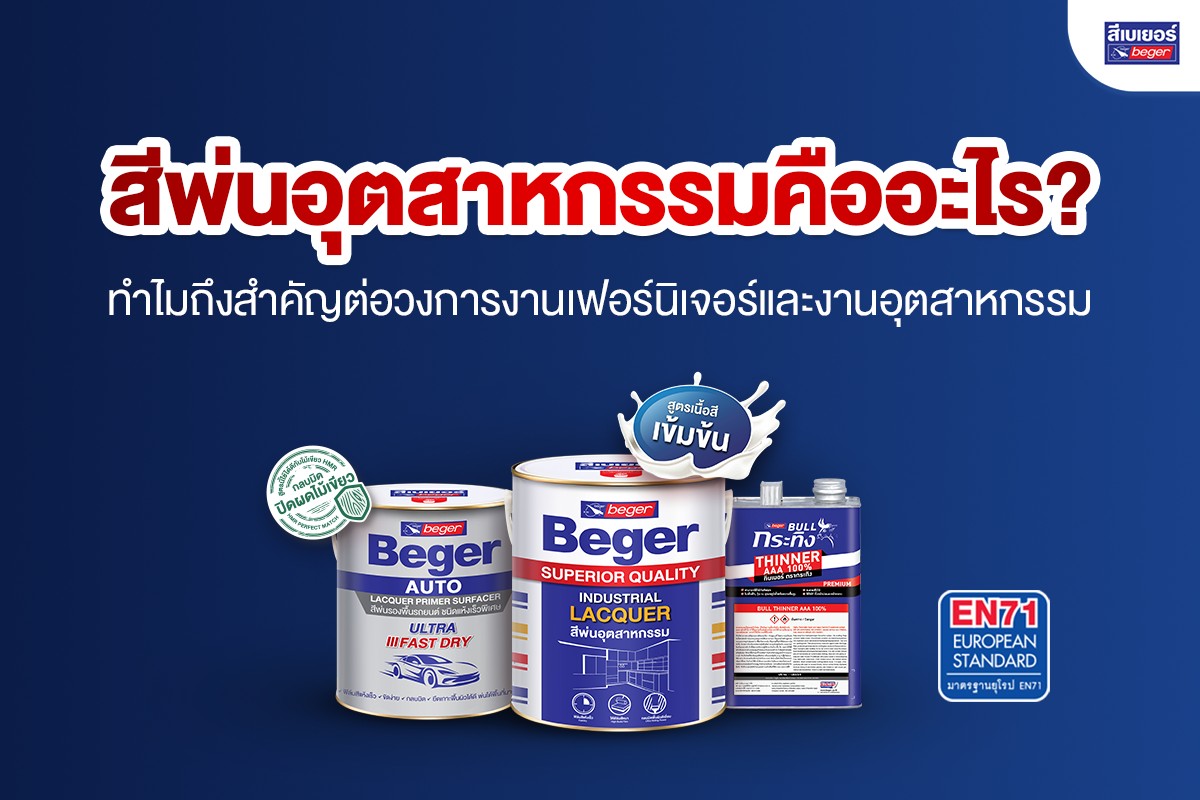
Industrial Spray Paint is a type of paint designed for coating workpieces in production systems, such as wooden furniture, metalwork, and factory parts, focusing on three main properties: fast drying, smooth and even paint film, and durability for actual use. The most commonly used type in furniture work is Industrial Lacquer or IL, which has a nitrocellulose resin base that dries exceptionally fast. This article will introduce you to all types of industrial spray paint, along with a comparison table and tips for selecting the right one for your surface and work characteristics.
What is Industrial Spray Paint?
Industrial Spray Paint refers to a group of paints developed for use with spray guns (Spray Gun or production line spray systems) instead of being applied with brushes or rollers. The key difference from regular paint is that industrial spray paint is formulated to have fine paint droplets, good flow, and dries much faster, allowing for multiple layers to be sprayed in a short time and enabling immediate transfer of workpieces to the next line.
In the Thai market, the term “industrial spray paint” often includes various resin-based paints, from nitrocellulose lacquer (NC) to epoxy and polyurethane, with each base providing distinct properties. Understanding the types is the first step in choosing the right one for your work.
How do Industrial Spray Paint and Regular Paint differ?
| Criteria | Industrial Spray Paint | Regular Paint (Brush/Roller) |
|---|---|---|
| Drying Speed | Dries quickly, allowing for fast layering, suitable for continuous production work | Dries slower, requiring wait time between coats |
| Surface Smoothness | Smooth and even, free of brush marks, showroom quality | May have brush/roller marks |
| Quality Control | Consistent across all workpieces, suitable for mass production | Depends on the skill of the craftsman each time |
| Required Equipment | Spray gun / spray booth + thinner mixed according to ratio | Brush, roller, easier to use |
| Suitable for | Furniture, built-in work, and factory pieces | Wall painting, general repair work on-site |
What types of industrial spray paint are there?
Industrial spray paint is divided into 5 main groups based on resin base, each suitable for different applications as follows:
| Type | Highlights | Limitations | Suitable for |
|---|---|---|---|
| Industrial lacquer (1L / NC Lacquer) |
Dries the fastest in the group, smooth and fine finish, easy to polish | Less resistant to chemicals/sunlight than 2K | Real wood furniture, MDF wood, color-coated surfaces, built-in work |
| Enamel / Alkyd (Enamel/Alkyd) |
Cost-effective, glossy, easy to use | Dries slower than lacquer, can yellow over time | General steel work, gates, indoor steel frames |
| Acrylic | Vivid colors, UV resistant, does not yellow easily | Medium film hardness | Items requiring vibrant colors and exposure to sunlight |
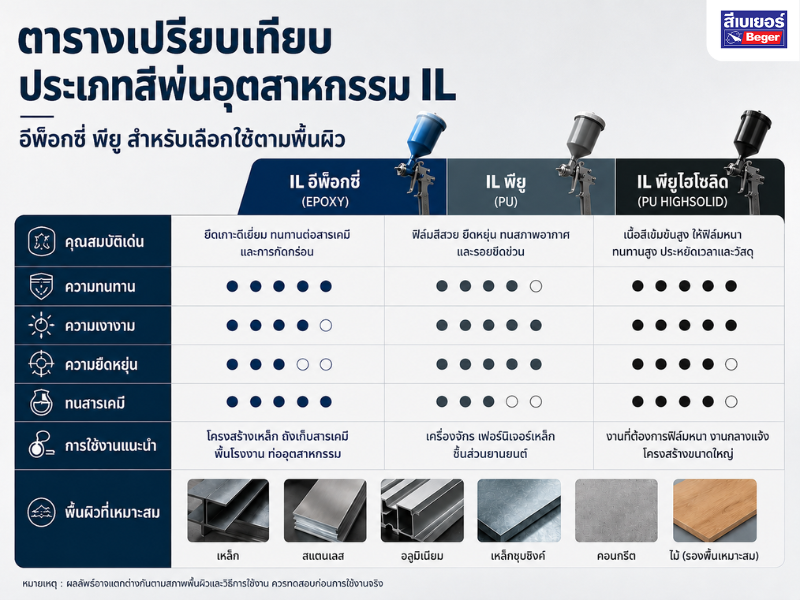
| Epoxy | Chemical, acid, alkali, and oil resistant, excellent adhesion to metal | Not UV resistant, will chalk when exposed to sunlight, requires a topcoat | Machine parts, steel structures, factory work |
| Polyurethane (PU / 2K) | Maximum strength film, UV resistant, scratch resistant, beautiful glossy finish | High price, requires mixing with Hardener, and has a limited working time (Pot Life) | Furniture work, outdoor parts, automotive, high-grade furniture |
Simple rule: For wood or furniture requiring speed and a smooth finish, choose IL; for metal exposed to chemicals, choose epoxy; for sun-exposed or premium grade work, choose PU
What is IL (Industrial Lacquer) spray paint, and why is it the standard for furniture work?
IL (Industrial Lacquer) is an industrial spray paint based on Nitrocellulose Resin that provides a thin but strong color film, dries quickly, and levels out exceptionally smooth, making it the standard paint for furniture factories and built-in work nationwide. The strengths of IL that meet real production needs are 5 points.
- Fast Drying The film dries very quickly, allowing for the next layer to be sprayed, the workpiece to be flipped, and sent to sanding-assembly stages quickly, directly increasing the productivity of the production line [insert statistics: approximate drying time/overcoat drying time of Beger IL according to actual TDS documents, specify actual reference source]
- Showroom quality smooth surface Good flow properties help reduce wave marks and spray marks, suitable for built-in cabinets, premium furniture, and interior decoration that requires high precision
- Adheres to multiple surfaces Can be used on real wood, MDF, particle board, and steel metal when paired with the correct primer
- Strong color film, durable for actual use Supports pieces that are frequently touched, such as cabinet doors, tables, and chairs, reducing scratches and wear
- Complete look adjustment Available in gloss (Gloss), semi-gloss (Semi-gloss), and matte (Matt) finishes with sharp, consistent shades in every production batch
Correct industrial spray paint system: Why must there always be a “primer”?
Short answer: Because the primer is the layer that allows the actual paint to adhere, be durable, and reveal the full shade Skipping the primer is a leading cause of paint peeling and color drop The surfaces of MDF, real wood, and steel have different porosity and absorption. Therefore, a professional spray paint system always consists of at least 2 layers working together, with the primer serving 5 functions
- Enhances adhesion Create a bonding layer between the material and the actual paint to reduce peeling problems and extend the life of the paint film.
- Smooth the surface to receive the actual paint. Fill in the pores and wood/MDF grain, easy to sand, making the topcoat smooth.
- Prevent moisture and rust. Acts as the first barrier against moisture penetrating the wood (reducing swelling, bulging, and mold) and prevents rust on metal work.
- Ensures the actual color is vibrant and true to shade, not dropping or dulling. Very important for difficult shades such as premium white, matte black, and earth tones.
- Increase the overall durability of the system. The structure of the primer film + actual paint is much more resistant to abrasion and heavy use than a single layer of actual paint. For furniture work, always pair IL color with Lacquer Primer Surface in the same system.
How to spray industrial paint to achieve professional results (step by step).
The standard procedure for industrial spray painting consists of 6 steps. Completing all steps will result in a smooth, durable finish with consistent color across all pieces.
- Prepare the surface. Sand the surface smooth, wipe off dust, oil stains, and moisture completely (wood should have moisture content not exceeding the level specified by the manufacturer).
- Spray primer suitable for the material. Use primer for wood/MDF or rust-inhibiting primer for steel, then allow to dry according to the specified time.
- Sand the primer with fine sandpaper. Smooth the surface before applying the actual paint, blowing off dust to ensure cleanliness.
- Mix the actual paint with thinner according to the manufacturer’s ratio.[Insert statistics: Ratio of paint: thinner for Beger IL according to actual TDS, e.g., 1: X — specify actual reference source] Mixing too thick or too thin is a primary cause of orange peel and paint running.
- Spray the actual paint in thin layers multiple times. Overlap the spray pattern by about 50%, maintain a consistent distance while spraying, and allow to dry between coats according to recommended times.
- Apply a topcoat (if desired). Choose the gloss level according to the design: gloss/semi-gloss/matte, and allow the film to fully cure before use or packaging for shipment.
Every step should adhere to the proportions and drying times from the product’s TDS document, and use paint that meets the relevant Thai Industrial Standards (TIS) for paints and varnishes.
How to choose industrial spray paint that suits your work?
Always answer these 3 questions before selecting paint: What material will it be sprayed on? What kind of environment will the workpiece encounter? How fast does the production line need to be?
| Your work characteristics | Recommended industrial spray paint |
|---|---|
| Solid wood furniture / MDF / Built-in interior work | Industrial lacquer IL + lacquer primer |
| Steel work inside buildings, steel frames | Enamel/alkyd or IL + rust-resistant primer |
| Steel workpieces exposed to chemicals and oil in factories | Epoxy + epoxy primer |
| Outdoor workpieces exposed to sun and rain / Premium grade work | Polyurethane (PU/2K) |
| Mass production work that requires quick turnover of workpieces | IL (fastest drying, easiest production queue control) |
For steel work specifically, such as box steel or galvanized steel with a smooth surface, additional adhesion precautions are necessary. Wooden work, both indoors and outdoors, also has its own specific color system.
Recommended products
FAQ about industrial spray paint
Q1: What is industrial spray paint?
A1: Industrial spray paint is a paint designed for coating workpieces in production systems, such as furniture and steel work, focusing on fast drying, smooth surfaces, and consistent quality across all workpieces. The popular type for furniture work is industrial lacquer (IL).
Q2: How many types of industrial spray paint are there?
A2: It can be divided into 5 main groups based on resin base: industrial lacquer (IL/NC), enamel/alkyd, acrylic, epoxy, and polyurethane (PU/2K). IL is notable for fast drying and smooth surfaces, while epoxy is known for chemical resistance, and PU is recognized for strength and UV resistance.
Q3: How does IL paint differ from regular paint?
A3: IL paint dries much faster, provides a smooth finish without brush marks, and ensures consistent quality across all pieces, making it suitable for furniture, tables, cabinets, built-in work, and mass production. In contrast, regular paint is more suitable for wall painting or repair work.
Q4: What materials can industrial paint be used on?
A4: It can be used on real wood, MDF, particle board, and metal. You must choose the primer that matches the material, such as lacquer primer for wood and rust-inhibiting primer for metal.
Q5: What causes an orange peel finish when using industrial paint?
A5: The primer helps improve adhesion, smooth the surface, prevent moisture in wood and rust in metal, and ensure the true shade of color appears fully without dropping. Skipping the primer is the main cause of premature peeling.
Q6: What causes an orange peel finish when using industrial paint?
A6: The main causes are incorrect thinner mixing ratios (too thick), spraying distance being too close or too far, or inappropriate air pressure. This can be resolved by mixing the paint according to the ratios specified by the manufacturer in the TDS and spraying in several thin layers.
Conclusion
Industrial paint is the heart of production work that requires speed, smoothness, and durability. Choosing the right type for the job is crucial: for furniture and built-ins, start with IL paint; for metal exposed to chemicals, consider epoxy; and for outdoor or premium work, use PU. Importantly, every system must always have the correct primer.