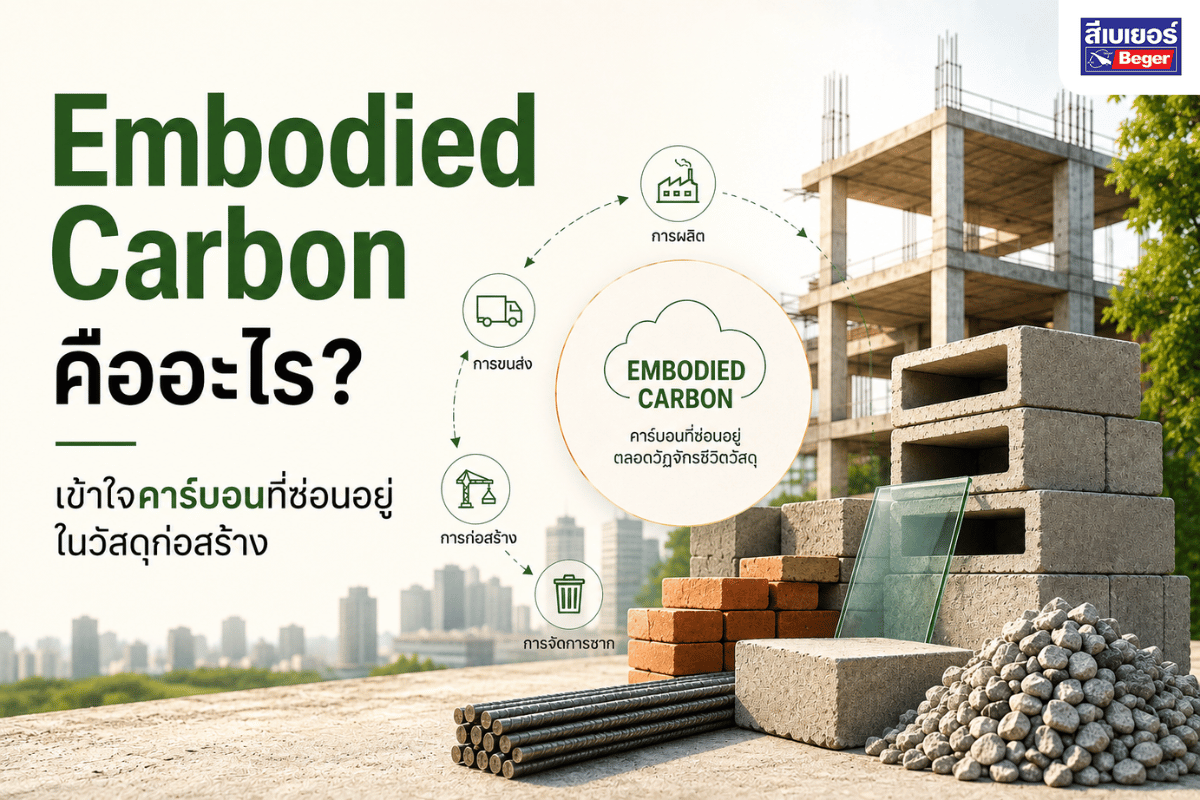
Currently, buildings and construction worldwide emit a total of 38% of all greenhouse gas emissions. This figure comes from a report by the UN Environment Programme and is not just from the electricity used in buildings but also includes the carbon hidden in every construction material we choose from the very first day of laying the foundation. This “hidden” carbon is what is known as Embodied Carbon, and over the past 5 years, it has become the most talked-about topic in the global construction and architecture industry. As buildings become increasingly energy-efficient, the proportion of Embodied Carbon becomes even more prominent. This article will explain the basics of what Embodied Carbon is, how it differs from the carbon we are familiar with, which types of construction materials emit the most, and where we can start measuring and reducing this value in our projects.
What is Embodied Carbon?
Embodied Carbon, or in Thai, referred to by some scholars as “คาร์บอนสะสมในวัสดุ,” is the total amount of greenhouse gases emitted throughout the life cycle of construction materials, from the extraction of raw materials, production, transportation, installation, to eventual demolition and disposal. Simply put, every time we use any material in construction, there is carbon “attached” to it, even though we cannot see it with the naked eye.
How does it differ from Operational Carbon?
Most people are familiar with “building carbon” in terms of energy used during occupancy, such as electricity for air conditioning, lighting, and elevators. These are referred to as Operational Carbon.
| Type | What is it? | Example | Occurs when |
| Operational Carbon | CO₂ from building usage |
Electricity, air conditioning, elevators |
Throughout the lifespan |
| Embodied Carbon | CO₂ hidden in materials |
Cement, steel, paint, glass |
From production to disposal |
Importantly, Operational Carbon can still be reduced in the future, such as by switching to renewable energy, but the Embodied Carbon that has already occurred during construction cannot be reduced retroactively. That is why scholars in sustainable buildings say that Embodied Carbon is “the most important carbon we need to decide on before designing.”
The Carbon Cycle in Buildings
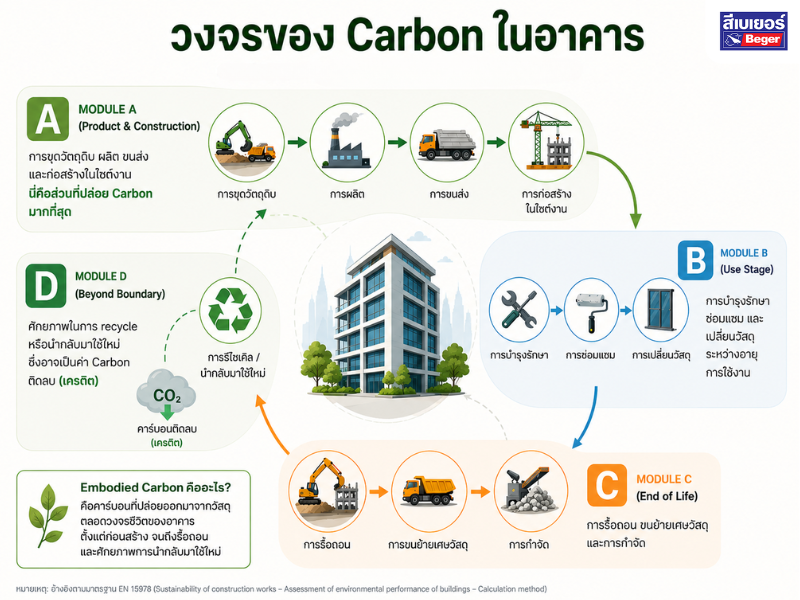
Scholars divide the life cycle of Embodied Carbon into 4 main stages according to the EN 15978 standard used in Europe and increasingly referenced in Asia.
- Module A (Product & Construction): The extraction of raw materials, production, transportation, and construction on-site. This is the stage that emits the most Carbon.
- Module B (Use Stage): Maintenance, repair, and replacement of materials during the lifespan.
- Module C (End of Life): Demolition, transportation of waste materials, and disposal
- Module D (Beyond Boundary): The potential for recycling or reuse, which may represent negative Carbon (credits)
Why is Embodied Carbon becoming increasingly important?
The numbers the world is watching
Before 2010, there was little discussion about Embodied Carbon because most buildings at that time consumed massive amounts of Operational Carbon, making it the primary metric. However, as buildings continue to improve energy efficiency, the numbers have changed. The Architecture 2030 Institute estimates that by 2050, Embodied Carbon will account for 49% of the total accumulated carbon in the building sector because Operational Carbon will decrease due to the use of clean energy, but Embodied Carbon will remain. For Thailand, which constructs residential projects and condominiums at a rate of hundreds of thousands of units per year, this figure is highly significant.
Which construction materials emit the most Embodied Carbon?
Not all materials emit Carbon equally. The metric used to measure this is called Global Warming Potential (GWP), measured in kgCO₂e per 1 kilogram of that material.
Comparison table of Carbon values in main materials
| Material |
kgCO₂e / kg |
Carbon Level |
|
Portland cement |
0.83 |
Very high |
| Structural steel (virgin) |
2.50 – 3.50 |
Very high |
|
Aluminum (virgin) |
8.00 – 11.00 |
Very high |
|
Concrete (C30/37) |
0.13 – 0.20 |
Moderate |
| Lightweight Block (AAC) |
0.35 – 0.45 |
Moderate |
|
Processed Wood |
0.40 – 0.80 |
Low-Moderate |
|
Building Paint (water-based) |
1.50 – 3.00 |
Moderate-High* |
|
Glass (float) |
0.85 – 1.20 |
Moderate |
*Note: The kgCO₂e value of paint appears high per kg but must be calculated from the actual painted area (approximately 0.2-0.4 kg/sq.m.), resulting in a net value per sq.m. much lower than structural materials.
Building Paint, slightly but counting every gram
Many people think that house paint has very little effect on the Embodied Carbon of buildings, but when multiplied by the actual area of large projects, the numbers start to become significant. For example, a condominium with 200 units that has a total painted area of 50,000 sq.m. If using paint with a different Carbon Footprint of 0.5 kgCO₂e/sq.m., that means a difference of 25 tons of Carbon — equivalent to driving a car for 150,000 kilometers. This is why Beger developed Paint CO₂ Cal to allow designers and contractors to calculate the Carbon Footprint from their choice of paint in projects immediately without needing an expert.
How to Calculate Embodied Carbon
Calculating Embodied Carbon is not something that requires an engineering degree, but it does require an understanding of the principles and the appropriate tools.
LCA (Life Cycle Assessment) Principles
LCA or Life Cycle Assessment is the international standard framework for measuring Embodied Carbon based on ISO 14040/14044 standards. The process is divided into 4 steps.
1. Define the Scope (Goal & Scope): Measure only Module A or the entire Lifecycle depending on the standards referenced.
2. Data Collection (Inventory Analysis): Quantity of each material + Emission Factor of that material
3. Impact Assessment: Calculate total kgCO₂e
4. Interpretation: Compare with baseline or established standards
What are CFP and EPD?
Carbon Footprint of Product (CFP) is the Embodied Carbon of one unit of product, calculated according to ISO 14067 standards. Materials with low CFP mean that they emit less Carbon during production.
Environmental Product Declaration (EPD) is a document prepared by manufacturers to report the Carbon values and other environmental impacts of products according to ISO 14025 standards. EPDs certified by third parties are considered the most reliable evidence for applying for a Green Building Certificate.
A tool for calculating Embodied Carbon with Paint CO₂ Cal
for calculating Embodied Carbon specifically from building paints Paint CO₂ Cal from BEGER is a free Web Application that requires no installation; it can be used immediately by simply opening a browser. What makes Paint CO₂ Cal different from typical tools is the use of the Carbon Footprint of Product (CFP) calculated from the actual production data of BEGER paint products in Thailand, rather than a global average that may deviate from the reality in the Thai context.
- Enter the painting area (sq.m.) and select the product
- The system calculates the CO₂ (kgCO₂e) instantly
- Compare between products to choose the one with lower Carbon
- Export results for use in project documentation
How are Green Building and Embodied Carbon connected?
TREES, LEED, EDGE — Do we need to submit Carbon data?
|
Standards |
Administrator |
About Embodied Carbon |
|
TREES |
TIIST (Thailand) |
There is a Materials category for EPD and local materials scoring. |
|
LEED v4.1 |
USGBC (United States) |
Scores Whole Building LCA and EPD directly. |
|
EDGE |
IFC / World Bank |
Focuses on Operational but starts to include Embodied in v3. |
|
BREEAM |
BRE (United Kingdom) |
Has a Mat01 category specifically for LCA. |
For projects in Thailand seeking TREES, which is a standard that many government agencies are beginning to mandate, having Carbon data from construction materials including building paints will directly support scoring in the Materials category.
Benefits for projects
- Higher Green Building Certificate scores, supporting sales/rentals in the ESG market.
- Responding to policies Net Zero of major real estate developers committed to the 2050 targets.
- Reducing risks from future regulations that may impose Carbon caps in construction.
- Building credibility with investors and shareholders concerned with ESG.
Where to start reducing Embodied Carbon?
Reducing Embodied Carbon does not require waiting for special budgets or a full team of experts. There are practical starting points available for every project.
1. Measure first, then reduce: Use tools like Paint CO₂ Cal to know the Carbon Baseline of the project before comparing material options.
2. Choose materials with EPD: Request EPD from the manufacturer before purchasing. Materials with EPD indicate that the manufacturer is transparent and responsible towards the environment.
3. Choose local materials: Short-distance transportation directly reduces Carbon in Module A.
4. Design for a long lifespan: Buildings that do not require frequent renovations reduce accumulated Embodied Carbon in the long term.
5. Choose low Carbon colors: Use Paint CO₂ Cal to compare Carbon values between paint products before making a decision. Even small numbers can be significant in large projects.
Frequently Asked Questions (FAQ)
Q1: Is Embodied Carbon different from Carbon Footprint?
A1: Embodied Carbon is part of the Carbon Footprint. The Carbon Footprint encompasses all CO₂ emissions from all activities, while Embodied Carbon specifically refers to the portion that comes from materials and construction processes.
Q2: Can existing buildings still reduce Embodied Carbon?
A2: For completed buildings, the Embodied Carbon generated during construction cannot be retroactively reduced, but there are still controllable aspects in Module B, such as choosing low Carbon colors for repairs or selecting materials with recycled content when replacing materials in the future.
Q3: Is Paint CO₂ Cal free to use or do I need a subscription?
A3: Paint CO₂ Cal is a web application developed by Beger that is available for free. No application installation is required; it can be accessed from any device through a browser. It is suitable for architects, contractors, project owners, and general consumers who want to know the Carbon impact of their color choices.
Q4: Are the Emission Factors in Thailand different from those in other countries?
A4: Yes, they differ significantly. Emission Factors depend on the energy sources and production processes in each country. Countries that use a high amount of renewable energy will have lower values than those that rely heavily on coal. Therefore, using Thailand’s specific values provides results that are significantly more accurate than the global average, which is something Paint CO₂ Cal has prioritized in its development from the beginning.
In summary, Embodied Carbon is no longer just a buzzword in the architecture industry but has become a measurable factor that impacts real decision-making in construction projects worldwide, and Thailand is following this direction.
- Embodied Carbon is the CO₂ hidden in materials, from raw material extraction to disposal — it cannot be reduced retroactively after construction is completed.
- Structural materials like steel and concrete emit the highest Carbon, but the paint used in large projects is also significant.
- The tool like Paint CO₂ Cal helps you calculate and compare the carbon value from paint instantly without needing special expertise.
If you are designing or managing a construction project, starting to measure Embodied Carbon today is the most important first step. Try using Paint CO₂ Cal to see how your color choices in your project affect carbon levels and choose better options immediately.